Dust is an inescapable byproduct of quarrying. From drilling and blasting to crushing, screening, and hauling, nearly every stage of the extraction and processing cycle generates airborne particulate matter. For quarry operators, this isn't merely a housekeeping issue; it is a complex challenge that intersects with stringent environmental regulations, worker health and safety, equipment longevity, and community relations. A single day of excessive visible dust can trigger complaints, halt operations, and lead to significant fines from agencies like the Mine Safety and Health Administration (MSHA) or local environmental bodies.
Traditional approaches to quarry dust control often default to the most obvious solution: applying large volumes of water. While water is essential, relying on it as a singular, unsophisticated strategy is inefficient. It evaporates quickly, especially in hot or windy conditions, creating a continuous cycle of reapplication that wastes a precious resource and can lead to over-saturation and runoff. The true operational cost isn't just the water bill; it's the fuel for constant water truck trips, the labor hours, and the production downtime on an unpaved road that's become a mud pit.
A modern, effective dust control strategy shifts the focus from simply "wetting" material to understanding the science of particle behavior. The goal is to change the physical properties of the fines, from fugitive airborne dust to agglomerated, settled particles that stay in place. This requires a systematic, data-driven approach that matches the right suppression technology to the right application point, guided by a proactive operational plan rather than reactive symptom management.
The first critical takeaway for any quarry manager is this: Effective dust suppression is achievable when a site-wide strategy matches specific control agents to each emission source, but success depends entirely on a systematic, monitored implementation plan.
What Is a Systematic Dust Control Plan and Why Is It Essential?
A systematic dust control plan is a comprehensive document that identifies every dust source within the operation and prescribes a specific, measured control method for each one. It moves beyond generalized suppression to create a tactical map of responsibility, scheduling, and performance metrics. Quarry dust control is not a one-size-fits-all problem, and a formal plan is the antidote to ad-hoc, reactive spraying.
The Core Components of an Effective Control Plan
A robust plan can be broken down into four sequential phases: identification, selection, implementation, and verification. Each phase is critical, and skipping any one of them will lead to control gaps.
- Source Identification and Characterization: A site survey must map every single emission point. A primary crusher generates dust differently than a transfer point on a conveyor belt, which is different still from a haul road. Characterize the dust—is it thick and continuous from drilling, or intermittent clouds from truck dumping? This phase determines the particle size and mechanical energy involved.
- Control Method Selection: For each source identified, a specific control agent and application method are chosen. This is the most technically nuanced phase. The choice isn't just between water and chemicals; it's about droplet size for airborne capture versus surface binding for long-term stabilization. We will detail these methods in the next section.
- Operational Implementation and Scheduling: This phase assigns clear responsibilities for applying treatments. It defines the who, when, and how. Is water spray bar activation at the jaw crusher automatic and interlocked with the motor, or manual? Is haul road treatment scheduled preventively before the morning shift, or reactively when a complaint comes in? A preventive schedule, often detailed in a digital calendar, is always more efficient than reactive treatment.
- Verification and Monitoring: A plan without verification is just a hope. This involves both direct visual observations and quantitative methods. A simple, effective field metric is the "visible dust opacity" standard, where an observer measures the percentage of light obscured by an emission plume. Other methods include dust deposition gauges at the site boundary and personal respirable dust monitors worn by workers to ensure compliance with permissible exposure limits (PELs).
How to Create an Operational Map of Dust Sources
A practical way to start is by using a site plan or a drone aerial image. Place a numbered marker on every source. A typical quarry map will include:
- Drilling rigs
- Blasting areas
- Primary crusher feed hopper
- Primary crusher discharge
- Secondary/tertiary crushers
- Screening decks
- Conveyor transfer points (head and tail pulleys)
- Stockpiles (loading and unloading)
- Haul roads (including intersections and traffic areas)
- Plant roadways and parking areas
This visual map becomes the central reference for the entire plan, ensuring no source is forgotten.
A Pre-Implementation Checklist: Essential Preparations for Quarry Dust Control
Before deploying any new suppression method or technology, certain foundational steps must be in place. Use this checklist to ensure your site is ready for a systematic rollout.
- □ Complete a formal emissions inventory: Document all sources per the operational map.
- □ Calibrate all water application equipment: Verify the flow rate (GPM) and pressure (PSI) of water trucks, spray bars, and misting cannons. An uncalibrated system can lead to massive over- or under-application.
- □ Establish baseline water quality: Test for total dissolved solids (TDS). High-sediment water will clog nozzles and chemically interfere with some dust suppression agents, reducing their effectiveness by up to 30%.
- □ Install meteorological monitoring: A simple weather station to log wind speed, direction, temperature, and humidity. Wind gusts over 15 mph can render misting systems nearly useless by stripping the curtain of droplets away from the source.
- □ Train all operators on the plan's specifics: A water truck driver must know the required application rate in gallons per square yard for a haul road, not just "drive down the road and turn on the spray."
- □ Define clear key performance indicators: Set measurable targets, such as "Reduce EPA Method 9 opacity readings at primary crusher discharge to below 10%" or "Maintain respirable quartz dust levels at operator positions below the MSHA PEL."
- □ Establish a communication protocol: Create a simple, fast way for workers to report dry spots or ineffective controls, such as a dedicated radio channel or a digital logbook.
The Core Methods: A Step-by-Step Technical Workflow for Dust Suppression
With a plan and preliminary checks completed, the next stage is executing the right control measures. A tiered, source-by-source approach using both mechanical and chemical methods is the industry standard for achieving effective quarry dust control.
Step 1: Capture Airborne Dust at Point Sources with Fine Water Fog
For fixed plant processes like crushing and screening, where dust is generated at a high energy point, the goal is to capture airborne particles quickly.
- Action: Install a dry fog or fine mist system. This technology uses a combination of air and water, atomized by specialized nozzles to create a dense curtain of droplets typically 1 to 10 microns in diameter.
- Purpose: The science here is particle agglomeration. A droplet must be roughly the same size as the dust particle to create a collision and encapsulate it. Conventional water sprays create large, 200-micron droplets that the tiny PM10 dust particles simply slipstream around, achieving only 30-50% control. A correctly sized dry fog system, however, can achieve a suppression efficiency of over 90% on respirable dust at enclosed transfer points.
- Expected Result: A visible, billowing cloud at a crusher hopper is replaced by a contained, clean airstream. The fog should fully engulf the source but not over-wet the material, which could cause bridging or screen blinding.
Step 2: Stabilize Haul Roads with Hygroscopic Salts for Long-Term Control
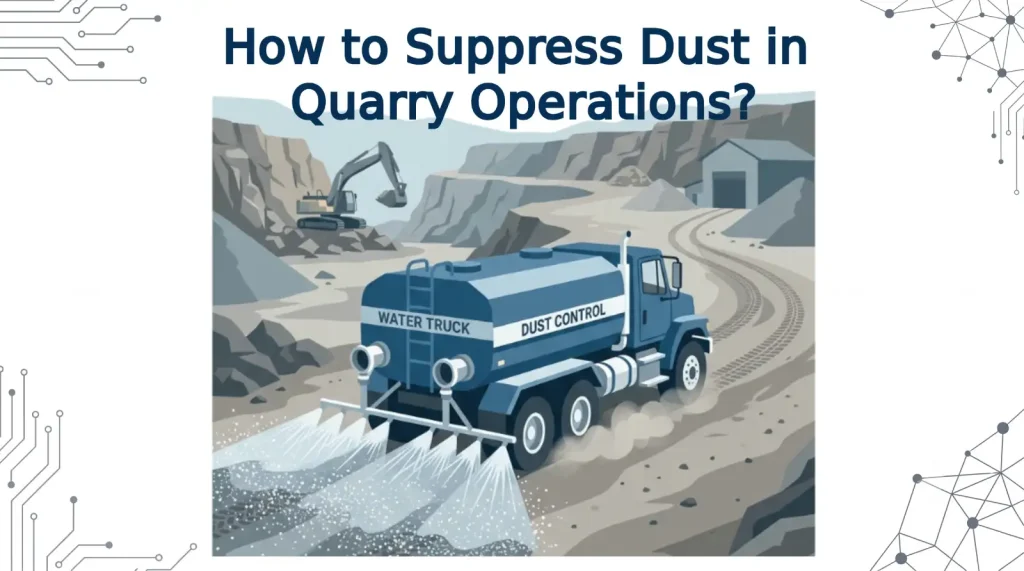
Haul roads can account for 40-60% of a quarry's total fugitive dust emissions. Water-only treatment is a losing battle here due to evaporation.
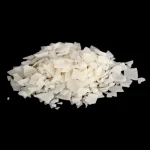
- Action: Apply a hygroscopic salt solution, such as calcium chloride (CaCl₂) or magnesium chloride (MgCl₂) , to the road surface. This is typically a liquid application from a dedicated spray truck, penetrating the top 2-3 inches of the road base.
- Purpose: These salts are desiccants that absorb moisture from the air, keeping the road surface continuously damp and flexible. They also reduce the surface tension of water, allowing it to better permeate the road base and bind the fine particles together. A single application can provide effective dust suppression for 4 to 8 weeks, compared to water, which may evaporate in under 2 hours on a 95°F day with 20% relative humidity.
- Expected Result: A treated, well-graded unpaved road will maintain a dark, slightly moist appearance and exhibit a stable, hard-packed surface with minimal loose aggregate. Vehicle speed becomes the primary variable for re-entrainment, a factor that must be strictly managed to no more than 15 mph on haul roads.
Step 3: Control Stockpile Emissions with Topical Crusting Agents
Working stockpiles, where material is constantly being added and reclaimed, require a flexible surface treatment.
- Action: Use a polymer emulsion or a blended, liquid crusting agent applied via a high-volume spray bar. The product coats the stockpile surface, creating a semi-permeable, flexible crust as it cures.
- Purpose: This crust physically binds surface particles against wind erosion across the entire stockpile face. Unlike a rigid asphalt or cement seal, a polymer crust is designed to be pliable. It resists cracking from the stockpile's natural slumping and settlement, maintaining integrity for 3 to 12 months. For active stockpiles, the area to be treated daily is limited to the final formed slope of the night's operation.
- Expected Result: A visual inspection should reveal a continuous, hardened surface layer, 1/4 to 1/2 inch thick, with no loose fines or signs of wind-blown particle trails. It should prevent dust lift-off in winds up to 40 mph when properly applied.
Comparing the Technical Arsenal: Which Method Is Right for Each Application?
Choosing the wrong suppression technology for the application is a common and costly mistake. The following decision matrix clarifies where each method excels.
Dust Suppression Agent Comparison
| Method | Mechanism | Best Application | Relative Cost | Key Limitation |
|---|---|---|---|---|
| Water Spray | Agglomeration | High-moisture processes (washing) | Low ($0.03–$0.08 per sq. yd.) | Rapid evaporation; poor fine particle capture. |
| Dry Fog System | Micronic agglomeration | Enclosed crushers, screens, transfer points | High ($18,000–$45,000 installed) | Requires consistent water/air pressure; ineffectual in high winds. |
| Hygroscopic Salts | Moisture retention, binding | Haul roads, plant roads, open areas | Medium ($0.15–$0.40 per sq. yd.) | Washes away in heavy rain; can be corrosive to untreated metal. |
| Polymer Emulsion | Surface crusting, binding | Stockpiles, berms, long-term inactive areas | Medium-High ($0.50–$1.20 per sq. yd.) | Requires proper cure time; breakable by heavy equipment traffic. |
| Surfactant-enhanced Water | Increased water penetration | Haul roads, short-term stockpiles | Low-Medium ($0.05–$0.15 per sq. yd.) | Still requires frequent reapplication; not a long-term binder. |
Decision Framework for Quarry Managers
Use this framework to guide your technology selection based on the specific emission source.
Choose a Dry Fog System when:
- The source is a point of mechanical action inside a plant structure.
- The dust is largely PM10 and PM2.5 (respirable).
- You cannot add significant moisture to the product material.
- The application point is sheltered from wind.
Choose a Hygroscopic Salt (like Calcium Chloride) when:
- The source is a large, trafficked area, most notably haul roads.
- A long residual effect of 4+ weeks is required to reduce application costs.
- You need a treatment that also compacts and strengthens the unpaved surface.
- The local climate is not an arid desert (some atmospheric humidity is needed).
Choose a Polymer Emulsion Crusting Agent when:
- The source is a long-term or large inactive stockpile face.
- You need a single-application solution to last an entire season.
- The surface must remain intact during weather events and wind.
- You need to prevent dust generation from a surface that won't be disturbed.
Troubleshooting Common Quarry Dust Control Failures
Even a well-designed plan can encounter problems. Here are four common operational failures and their solutions.
Symptom: Dust cloud escaping from an enclosed transfer point despite a running dry fog system.
- Solution: First, inspect all nozzles for clogging, especially if unfiltered water is used. A single clogged nozzle can create a gap in the fog curtain. Second, check the air-to-water pressure ratio at the nozzle manifold. A deviation of more than 5 PSI from the manufacturer's specification will produce droplets of the wrong size. Finally, verify the enclosure's integrity—any gaps or holes create a "chimney effect" that sucks the fog out before it can bind with the dust.
Symptom: A calcium chloride-treated haul road is corrugating and dusty within two weeks.
- Solution: This indicates a failure in the road base structure, not the chemical. The treatment is binding a loose layer of fines on top of a hard, compacted subsurface. Rip and regrade the road with a motor grader to a proper 2-3% crown, introduce binding fines if the material is too clean, thoroughly compact it with a sheepsfoot roller, and then reapply the calcium chloride treatment. The salt stabilizes a good road; it cannot build one.
Symptom: A polymer crust on a stockpile has cracked, and dust is emitting from the fissures.
- Solution: A cracked crust usually means it was applied too thickly, causing it to become overly brittle. For the repair, do not simply spray over the cracks. Clean out the loose material from the fissures and apply a new, thinner coating to the affected area. For future applications, reduce the per-pass application rate by 20-30% and apply multiple thin layers, allowing each to partially cure.
Symptom: Water truck spraying is creating mud and runoff, but not solving the dust.
- Solution: This is classic over-watering. The instantaneous application rate is exceeding the infiltration capacity of the soil. The operator must increase the truck's ground speed or reduce the spray bar's flow rate to apply a targeted dose of 0.3 to 0.5 gallons per square yard. The goal is to uniformly dampen the surface without creating any puddling or runoff, which actively mines the fine material from the road.
Where Is Quarry Dust Control Technology Heading?
The field of dust suppression is evolving from a compliance-driven cost center to a data-driven operational efficiency tool. The most significant trend is the integration of real-time monitoring and automation. Sensor networks are moving beyond fixed boundary monitors to include directional, source-specific particulate monitors that are linked directly to a plant’s PLC. When an opacity sensor at a crusher discharge detects a 20% threshold, it can automatically trigger a sequence: increasing fog system pressure, slowing the feed conveyor, and sending an alert to the control room. This closed-loop system ensures 24/7 compliance without operator intervention.
Another important development is the rise of bio-based and renewable synthetic fluids as alternatives to traditional hygroscopic salts in environmentally sensitive watersheds. These products, derived from beet juice extracts or modified plant gums, offer a lower chloride footprint while providing effective road stabilization and dust binding. They are particularly valuable in regions with strict chloride discharge limits or near sensitive aquatic habitats. These next-generation methods and technologies are redefining what effective, sustainable quarry dust control means for the industry.
A 12-Step Checklist for Continuous Dust Control Excellence
Achieving sustained quarry dust control requires ongoing operational discipline. This checklist serves as a daily, weekly, and monthly management tool.
- □ Daily: Visually inspect all water spray nozzles and fog heads for clogging and proper spray pattern.
- □ Daily: Verify water truck application rates and coverage maps; log all treated areas.
- □ Daily: Monitor the weather forecast, particularly for high wind (>15 mph) and extreme heat events, to adjust preventive schedules.
- □ Weekly: Perform Method 9 visible emission readings on a rotating schedule of all major sources.
- □ Weekly: Check moisture content of a treated haul road at a depth of 2 inches using a field probe.
- □ Monthly: Calibrate the water truck’s flow meter and the pumping systems for chemical suppressants.
- □ Monthly: Conduct an integrated site walk-down with the health and safety team to identify any new or missed sources.
- □ Quarterly: Review your entire dust control plan against production changes; a new crusher or relocated stockpile requires a plan update.
- □ Quarterly: Collect and analyze personal dust monitor data for all high-risk job roles (crusher operator, water truck driver).
- □ Annually: Perform a life-cycle cost analysis comparing your current suppression program’s total cost (chemicals, water, labor, fuel) to alternative technologies.
- □ Annually: Provide refresher training for all personnel on dust control principles and the specifics of your site’s plan.
- □ As needed: Investigate any formal community complaint within 24 hours, document the cause, and implement a corrective action.
Conclusion
Effective quarry dust control hinges on a systematic, planned approach rather than reactive measures. The core principle is source-specific suppression: matching precise technology—from dry fog systems that capture airborne particles to hygroscopic salts that stabilize haul roads for weeks—to the unique mechanics of each emission point. A data-driven implementation, guided by a rigorous plan, is the only way to achieve consistent compliance, protect worker health from respirable silica, and maintain good community standing.
The long-term success of any program relies on continuous monitoring and verification. Using tools like Method 9 opacity readings and personal dust monitors transforms suppression from a guess into a measurable science. For operators aiming to build such a system, the path forward begins with a comprehensive site audit. Identify every source, calibrate every piece of application equipment, and design a prevention-based schedule that treats the cause of dust generation, not just the visible symptom of a dust cloud.
FAQs
What is the most effective method for quarry dust control?
The most effective approach is a systematic, multi-method strategy, not a single technology. It combines fine water fog for airborne dust in processing plants, hygroscopic salts for long-term haul road stabilization, and polymer crusting agents for stockpile surfaces. The method must be matched to the specific source to be effective.
How does a dry fog dust suppression system work?
A dry fog system uses compressed air and water forced through specialized nozzles to create a dense curtain of ultra-fine droplets, 1 to 10 microns in diameter. These droplets are sized to collide with and agglomerate respirable dust particles. Unlike water sprays, they suppress dust without adding significant moisture to the material.
Why is water alone often insufficient for dust suppression on haul roads?
Water’s high evaporation rate is the primary reason it fails on haul roads. On a hot, dry day, water can evaporate in under two hours, requiring constant reapplication. This leads to high water and fuel costs, while the frequent wet-dry cycles can actually degrade the road surface by pulling fines to the top, which then become loose dust.
Is calcium chloride better than water for dust control?
For unpaved road surfaces, calcium chloride is significantly better than water for long-term control. It is hygroscopic, drawing moisture from the air to keep the road continuously damp, and it binds fine particles together to create a hard, compacted surface. A single application can last 4 to 8 weeks, replacing dozens of water truck trips.
What are the specific health risks of quarry dust?
The most serious health risk comes from respirable crystalline silica (RCS), a component of many rocks. Inhalation of RCS can cause silicosis, an irreversible and potentially fatal lung disease, and is classified as a human carcinogen by the International Agency for Research on Cancer (IARC) . Other risks include chronic obstructive pulmonary disease (COPD) and aggravation of existing respiratory conditions.
How can I measure the effectiveness of a dust control program?
Effectiveness is measured by combining direct visual methods with quantitative data.
- Visual: Use EPA Method 9 to measure the opacity of a dust plume.
- Personal monitoring: Equip workers with respirable dust monitors to measure exposure against MSHA permissible exposure limits (PELs).
- Deposition: Use dust fall buckets or deposition gauges at the site boundary to track off-site migration.
What role does vegetation play in controlling quarry dust?
Vegetation acts as a passive, highly effective control measure for perimeter and reclaimed areas. Trees and shrubs act as a physical windbreak, reducing wind speed and its ability to entrain particles. Plant root systems also stabilize soil, preventing erosion. A dense, tiered vegetated berm can be a quarry’s best defense for community relations.
How often should haul roads be treated with chemical dust suppressants?
The treatment frequency depends on the product, traffic volume, and weather.
- Calcium chloride: A well-graded and compacted road may only need treatment every 4 to 8 weeks.
- Surfactant-based treatments: They degrade faster and may require reapplication every few days or weekly, similar to a high-frequency water program. Blading the road to the proper crown before treatment is essential for longevity.
Can dust control chemicals contaminate ground or surface water?
Contamination is a risk if application is uncontrolled and heavy, particularly with chloride-based salts. The primary risk is over-application leading to runoff. A proper operational plan mitigates this by using precise, calibrated application rates that ensure all product is absorbed into the road surface. The goal is to bind the chemical to the road, not wash it off.
When should I use a polymer emulsion instead of a salt-based stabilizer?
Choose a polymer emulsion when the target area won’t be disturbed for an extended period. A polymer forms a physical, semi-flexible crust over the surface, making it ideal for long-term stockpiles, berms, or slopes where a single-application, season-long solution is needed and future penetration by traffic is not expected.