Winter maintenance professionals and facility managers face a perennial decision when ice and snow threaten safety and operations: should you deploy a liquid deicer or stick with traditional granular compounds? The wrong choice can lead to wasted budget, environmental damage, or, most critically, unsafe surfaces. The core of the dilemma lies not in which option is universally "better," but in understanding the specific conditions, goals, and constraints of your site. This guide breaks down the performance, cost, and application differences between liquid and granular deicers to provide a clear decision-making framework.
The quick answer is that one form isn't universally superior. A liquid deicer works fastest for anti-icing and penetrating thick ice, while granular products excel at breaking through hard-packed snow and providing immediate traction. The optimal strategy for most commercial sites involves using both, deployed at the right time and for the right task. We’ll deconstruct the mechanisms, costs, and best-use scenarios for each.
What Is a Liquid Deicer and How Does It Work?
A liquid deicer is a freeze-point depressant dissolved in water, typically applied as a spray or brine before or during a winter storm. Unlike solid granules that must first dissolve into a brine to begin melting, a liquid deicer is already in its active state, which means it begins working on contact with the ice or pavement.
The most common base chemical for liquid deicers is calcium chloride, known for its exothermic reaction when it dissolves, which releases heat and accelerates melting. Other formulations include sodium chloride brine and magnesium chloride. Liquids are applied at rates often ranging from 10 to 50 gallons per lane mile for anti-icing, dramatically less material by weight than solid applications.
What Are Granular Deicers and Why Are They Still the Industry Standard?
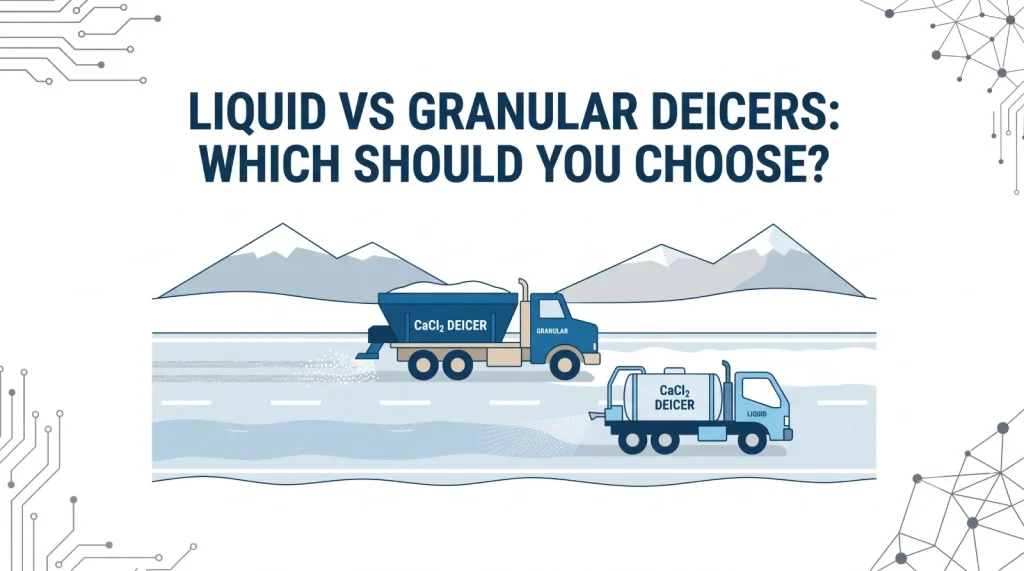
Granular deicers are solid, crystalline compounds broadcast directly onto icy or snow-covered surfaces. They remain the most visible winter maintenance tool, accounting for a significant majority of the deicing market by volume. Their widespread use is driven by low upfront material cost, simple storage requirements, and the immediate friction they provide underfoot or under-tire.
Common active ingredients in granular deicers include rock salt (sodium chloride), calcium chloride pellets, and magnesium chloride flakes. The key functional difference is a required two-step process: the granule must first absorb moisture from the environment or from the ice itself to form a liquid brine, which then initiates the melting process. This means granular products inherently have a lag time, especially in very cold, dry conditions where available moisture is limited.
How Do Liquid and Granular Deicers Differ in Mechanism?
The primary difference is the presence or absence of water. A liquid deicer provides the water needed for the melting reaction instantly. A granular deicer must find that water from its surroundings. This single fact explains most performance gaps. At 15°F (-9°C), a granule of calcium chloride may take several minutes to begin visibly melting ice, while a liquid calcium chloride spray will be actively melting within seconds. This makes liquids the clear winner for anti-icing, a proactive strategy where a barrier layer is applied before a storm to prevent ice from bonding to the pavement.
Where Does Liquid Deicer Outperform Granular Options?
Liquid deicers demonstrate a clear performance advantage in several specific scenarios. The following comparison table details the primary application factors:
| Factor | Liquid Deicer | Granular Deicer |
|---|---|---|
| Activation Speed | Instantaneous on contact | Delayed; must form a brine first |
| Anti-icing Capability | Excellent; forms a bond-breaking barrier | Poor; material can be blown off by traffic or wind |
| Penetration of Thick Ice | High; seeps into cracks and delaminates ice layers | Low; acts from the top surface down |
| Residual Effect | Can be short; runs off unless formulated with residual agents | Longer residual activity as solids slowly dissolve |
| Precision Application | High; can be controlled with spray patterns | Lower; scatter and bounce occur on impact |
| Lowest Effective Temp | -25°F (-32°C) for calcium chloride brine | -25°F (-32°C) for calcium chloride pellets |
Liquid deicers are the preferred tool for anti-icing bridges, steep grades, and runways where even a thin ice bond can be catastrophic. Their ability to be applied days before a storm and remain effective, particularly with calcium chloride-based formulas that resist evaporation, provides a critical operational window.
When Is a Granular Deicer the Better Choice?
Despite the technical advantages of liquids, granular deicers remain indispensable for specific conditions. Their greatest strength is penetrating and breaking up hard-packed snow after traffic has compressed it. A sharp, angular granule can punch through the snow layer and release melting energy directly at the pavement interface.
Granular products also provide immediate traction, a secondary benefit that liquid applications simply cannot offer. For a pedestrian walkway where a slip-and-fall claim is a liability concern, the grit provided by undissolved granules offers instant friction. Furthermore, a granular deicer does not require specialized liquid storage tanks, pumps, or spray systems, making it more accessible for smaller operations or sites without dedicated deicing infrastructure.
What Are the Cost and Operational Differences?
Cost comparisons between liquid and granular deicers are more complex than a simple per-ton price. A comprehensive analysis must account for application efficiency, material loss, and infrastructure corrosion.
Material Costs: Pure rock salt is typically the cheapest granular material per ton, often costing $50 to $80 per ton. Calcium chloride pellets are a premium granular product at $350 to $700 per ton. Liquid deicers vary widely; sodium chloride brine is extremely cheap to produce (often $0.10 to $0.50 per gallon), while manufactured calcium chloride liquid concentrates are more expensive.
Operational Efficiency: The critical metric is "cost per lane mile per storm." A study by the Federal Highway Administration (FHWA) indicates that pre-wetting granular salt with a liquid deicer can reduce total material usage by 25% to 30% due to reduced bounce and scatter. Direct liquid application for anti-icing uses 60% to 70% less material by weight than a typical granular de-icing treatment, translating to fewer truck trips and lower fuel costs.
Application Logistics: Liquid anti-icing can be performed at highway speeds (up to 35 mph), covering more ground per hour. Granular spreading is often slower to ensure a uniform pattern. However, liquids require dedicated, more expensive on-site storage, including polyethylene tanks and secondary containment, whereas bulk granular salt can be stored in a simple fabric-covered pile or dome.
How to Calculate the True Cost of Ownership?
- Calculate material application rate per acre for both a granular and liquid option under a standard scenario (e.g., a 2-inch snow event at 25°F).
- Add an estimated material loss factor: Use 30% to 50% loss for dry granular scatter and traffic blow-off; use 5% to 10% for a precision-sprayed liquid.
- Incorporate equipment cost amortization: A liquid spray system and storage tanks represent a higher initial capital expenditure than a pickup-mounted salt spreader.
- Factor in corrosion and infrastructure damage: The FHWA estimates that winter road maintenance corrosion costs U.S. drivers $3.4 billion annually. Using a liquid deicer with a corrosion inhibitor can reduce this by 70% to 90% compared to dry rock salt.
Liquid vs Granular Deicers: Environmental and Infrastructure Impact
All chloride-based deicers pose some environmental and corrosive risk. The critical variable is not the form but the total pounds of chloride applied to the environment. However, form indirectly drives impact through application efficiency. Because liquids reduce bounce and scatter, significantly less material can be used to achieve the same result, directly lowering the total salt load on adjacent soil, vegetation, and waterways.
For infrastructure, the presence of water in a liquid deicer makes it more immediately electrochemically active, meaning it can initiate corrosion faster than a dry granule. However, high-quality formulated liquids often include measured doses of corrosion inhibitors, a precise control that is difficult to achieve with uncoated granular products. A calcium chloride liquid deicer, when formulated with a high-performance corrosion inhibitor, can be less damaging to steel-reinforced concrete and vehicle frames than a heavy application of dry rock salt.
How to Choose the Right Deicer Strategy for Your Site
A modern, efficient, and cost-effective winter maintenance program rarely uses only one form. The optimal strategy is a hybrid approach: liquids for proactive anti-icing and granulars for reactive de-icing and traction.
Choose a liquid deicer as your primary tool when:
- Your goal is anti-icing: preventing ice from bonding.
- You are treating high-speed roadways where granular scatter is a major loss factor.
- You have the budget for specialized application and storage equipment.
- The lowest effective temperature is a primary concern (use calcium chloride-based liquids).
Choose a granular deicer as your primary tool when:
- You need immediate traction on a thick, bonded ice pack.
- You are managing a small site without liquid storage infrastructure.
- You are addressing post-storm hard-packed snow and ice.
- You require a low per-ton upfront material price and can accept higher application rates.
Choose a hybrid approach to:
- Pre-wet granular salt with a sodium chloride or calcium chloride brine to cut scatter by up to 30%.
- Use direct liquid application for open, wind-prone areas and granular for sheltered, high-traction zones.
- Apply a granular deicer for fast response and follow up with a liquid for residual control.
What Are Common Mistakes to Avoid When Switching to Liquids?
Transitioning from a purely granular program to one that includes liquid deicers is a source of frequent, costly errors. Recognizing these common mistakes can save a department significant money and performance headaches.
- Mistake: Using liquid deicers exactly like granulars. A reactive anti-icing program that sprays brine onto a 6-inch snowpack will fail. Liquid anti-icing must be applied to a bare or nearly bare surface before the storm.
- Mistake: Underestimating the importance of brine concentration. An incorrectly made brine that freezes on the truck is a logistical nightmare. A eutectic concentration for a calcium chloride brine is roughly 32% by weight, which gives a freeze point near -60°F (-51°C) . Improper mixing can result in a frozen tank.
- Mistake: Ignoring pavement temperature. Air temperature is not a reliable guide. Pavement can be significantly colder, especially on bridges. Applying a thin liquid deicer to pavement below 15°F requires precise rate adjustments and may benefit from an added heat source from an exothermic material like calcium chloride.
- Mistake: Neglecting operator training. The most precise, expensive liquid spray system is worthless if an operator doesn’t understand calibration, nozzle selection, or application rates. The shift requires a change in mindset from "tons per mile" to "gallons per lane mile."
Conclusion
The decision between a liquid deicer and a granular option is not a binary choice but a strategic allocation of resources. A liquid deicer, particularly one based on calcium chloride, provides unmatched speed for anti-icing and penetrating effectiveness, enabling a proactive, low-material-use strategy. Granular products remain irreplaceable for reactive de-icing of packed snow and providing immediate, critical traction.
The path forward for most commercial sites is a data-driven hybrid model. By carefully matching the product form to the specific phase of a storm—and supplementing granular applications with strategic pre-wetting or anti-icing liquids—facilities can enhance safety, lower their total chloride footprint, and achieve a superior cost-per-lane-mile outcome. Begin by auditing your current material loss rates and pavement temperature data to identify the precise scenarios where a shift to liquids can deliver the highest return on investment.
FAQs
What is the main advantage of a liquid deicer over granular?
The primary advantage is instantaneous melting. A liquid deicer is already in a brine solution, so it works on contact with ice and does not require external moisture to activate. This makes it ideal for anti-icing.
How effective is a liquid deicer at very low temperatures?
Effectiveness depends on the chemical. A calcium chloride-based liquid deicer can be effective down to -25°F (-32°C) . In contrast, a sodium chloride brine starts to freeze and lose effectiveness around 15°F (-9°C).
Does a granular deicer work faster than a liquid?
No, not in terms of melting speed. A granular deicer must first dissolve into a brine, which introduces a delay. However, a granule can physically punch through a layer of hard-packed snow to start melting at the pavement interface faster than a liquid that is pooling on top.
Is pre-wetting granular salt the same as using a liquid deicer?
Not exactly. Pre-wetting involves spraying a liquid onto the granules as they leave the truck to improve adhesion and activation. It combines benefits of both forms but is still a reactive de-icing treatment. Direct liquid application is a dedicated anti-icing or de-icing operation.
Which type of deicer is better for a concrete driveway?
For a standard concrete driveway, begin with a liquid calcium chloride for anti-icing before a storm. If snow accumulates, a light application of granular calcium chloride can break the bond. Avoid aggressive ammonium-based fertilizers, which will chemically destroy the concrete surface.
What is the shelf life of a liquid deicer?
The shelf life is long if storage is correct. A properly sealed, contained liquid deicer stored away from extreme heat and direct sunlight can remain effective for 2 to 5 years. The tank must be correctly vented and constructed of compatible material (like polyethylene) to avoid corrosion.
Can you mix different types of granular deicers?
Physically mixing granules in a spreader is possible but rarely recommended. Different bulk densities and particle sizes will cause the blend to segregate, with heavier particles like calcium chloride settling to the bottom, resulting in an inconsistent application rate.
What equipment is needed to apply a liquid deicer?
Basic application requires a polyethylene storage tank, a chemical-resistant pump, and a spray boom or handheld wand with nozzles calibrated for a specific gallons-per-acre output. More advanced systems include flow meters, GPS controllers, and automated pre-wet kits.
Does a granular deicer provide better traction?
Yes, for a period of time. Undissolved granular deicer particles provide direct mechanical friction. However, a liquid is completely smooth, which is why it is never used for immediate, emergency traction on top of a deep snowpack.
Are liquid deicers more corrosive than granular rock salt?
In their raw state, all chlorides are corrosive. A liquid can be more immediately electrochemically active. However, precision-applied liquids with corrosion inhibitors often deposit significantly less total chloride per square yard than a heavy granular application, resulting in lower overall corrosion potential.