Global supply chains for industrial chemicals are under more pressure than ever. For procurement professionals, the question of where to source Calcium Chloride — directly from a manufacturer or through a distributor — has become a strategic decision that impacts cost, reliability, and operational efficiency. Shipping delays, fluctuating raw material costs, and inconsistent product quality have made the old "just call the usual supplier" approach a significant business risk.
The choice is not always straightforward. A manufacturer might promise the lowest price-per-ton, but hidden costs in logistics, payment terms, and minimum order quantities can quickly erode those savings. Conversely, a distributor offers flexibility and local support, but questions about traceability and markup transparency often arise.
This article provides a data-driven framework to answer the "manufacturer vs distributor" question specifically for Calcium Chloride sourcing in 2026. We examine the full cost of ownership, quality assurance mechanisms, supply chain resilience, and the specific conditions under which each model makes the most sense for your operation.
Calcium chloride sourcing directly from a manufacturer can deliver 15-25% lower unit costs, but only if your order volumes meet minimum thresholds and you have the infrastructure to manage international logistics and quality verification. The optimal choice depends entirely on your company’s annual consumption volume, technical quality requirements, geographic location, and risk tolerance.
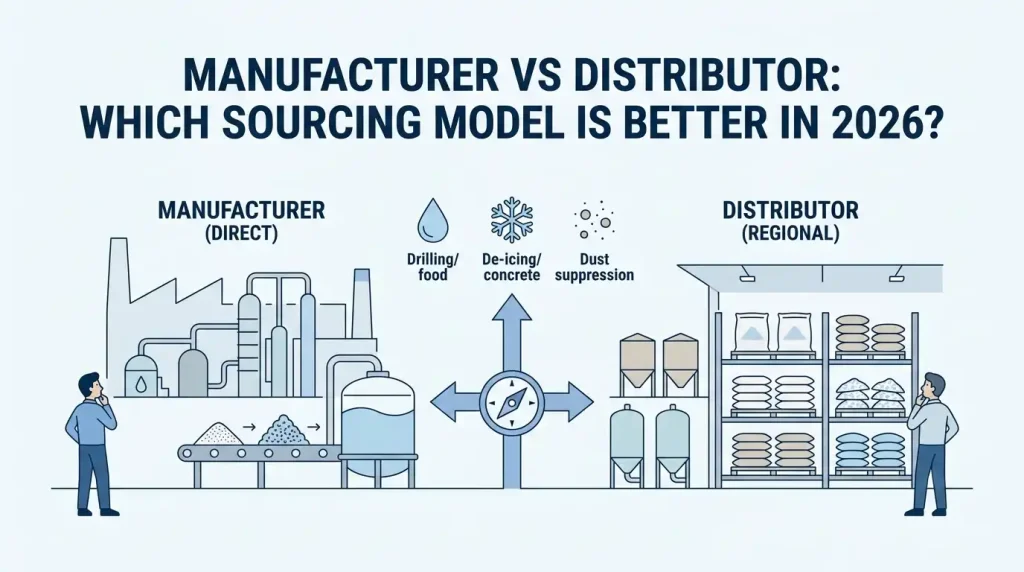
What Makes the Manufacturer vs Distributor Decision Critical for Calcium Chloride in 2026?
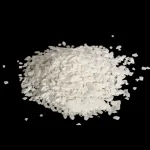
Calcium Chloride is not a single, simple commodity. It exists in multiple forms — anhydrous pellets (94-97% purity), dihydrate flakes (77-80% purity) , and liquid solutions (28-42% concentration) — each with distinct supply chains, storage requirements, and end-use applications. A distributor might excel at supplying liquid calcium chloride regionally, where freight costs make long-distance shipping uneconomical. A manufacturer in China or the US, however, might be the only viable source for high-purity anhydrous pellets used in industrial desiccation or concrete acceleration.
The global Calcium Chloride market is projected to reach approximately 2.1 billion USD by 2026, driven by demand from de-icing, dust control, oil and gas drilling fluids, and food-grade applications. This growing demand, combined with the energy-intensive nature of production and rising logistics costs, has made the procurement landscape more complex. A wrong sourcing decision can tie up working capital in slow-moving inventory or leave a production line starved of a critical input.
Understanding the structural differences between the two models is the first step. A manufacturer controls the production process, from raw material (often limestone and hydrochloric acid or the Solvay process byproduct) to the final packaged product. A distributor aggregates demand from multiple customers, providing warehousing, inventory management, and last-mile delivery. The value each brings depends on what you, the buyer, are optimizing for.
Manufacturer Direct vs Distributor: A Head-to-Head Comparison
The following table breaks down the key differentiating factors across seven critical dimensions for a procurement decision-maker.
| Comparison Dimension | Sourcing Directly from Manufacturer | Sourcing Through Distributor |
|---|---|---|
| Cost Per Unit | Lower base price, typically $180-$280 per metric ton (anhydrous, FOB). Subject to raw material (HCl) price fluctuations. | Higher base price, typically $250-$380 per metric ton. Price is more stable and includes logistics and warehousing services. |
| Minimum Order Quantity | High. Often 1 to 5 full container loads (20-100 MT per shipment). | Low to flexible. Can purchase by the pallet (1-2 MT) or scheduled smaller releases from a blanket order. |
| Quality Control & Traceability | Direct access to batch-specific COA, production records, and plant audits. Ideal for ISO 9001 or FSSC 22000 compliance requirements. | Traceability depends on the distributor's systems. A reputable distributor will provide a Certificate of Analysis (COA) and retain samples, but a plant audit is indirect. |
| Supply Chain Risk | Concentrated risk. A production shutdown, port congestion, or single freight lane disruption can halt your entire supply. | Diversified risk. Distributors often hold buffer stock from multiple sources and in multiple locations, insulating you from a single point of failure. |
| Technical Support | Deep but narrow expertise focused on their specific product grade and production method. | Broad, application-oriented support. A distributor serving multiple industries can advise on the best grade for a niche food processing or dust control application. |
| Logistics & Lead Time | Long and rigid lead times (4-8 weeks for ocean freight). Buyer is responsible for freight forwarding, customs clearance, and demurrage. | Short and flexible lead times (1-5 days for stocked product). Distributor manages all importation and last-mile delivery to your facility. |
| Payment Terms & Financing | Often requires TT, Letters of Credit (L/C), or 30% prepayment, which ties up significant working capital. | More common to offer Net 30, 60, or 90-day open credit terms after an established relationship, improving your cash flow. |
Why Does Product Purity Make a Manufacturer the Better Choice?
For high-stakes applications, the purity of Calcium Chloride is non-negotiable. A food-grade calcium chloride used in cheese making or canning requires strict limits on heavy metals like lead and arsenic. An anhydrous pellet used in a nitrogen blanket or inerting system must not introduce moisture. In these scenarios, sourcing directly from a manufacturer who can provide a detailed Certificate of Analysis for each batch is critical.
A distributor handling multiple grades of calcium chloride in the same warehouse might not have the same level of quality segregation. While they can provide a COA, you are placing your trust in their repackaging and handling procedures. If your specification requires a purity of 94-97% anhydrous with less than 0.1% magnesium and alkali metal chlorides, a direct relationship with the manufacturer’s technical team allows you to lock in a specification and, crucially, verify it through a third-party inspection at the source before shipment. This is the only way to ensure that what you buy is exactly what you get, a safeguard that is often cost-prohibitive with a distributor’s smaller parceled lots.
How Do Logistics Costs Flip the Distributor Advantage for Liquid Calcium Chloride?
Liquid Calcium Chloride is a logistics-driven market. A 32% solution is roughly 70% water. Shipping a truckload of water across an ocean is an obvious economic error. This is where the manufacturer vs distributor analysis produces a clear answer: distributors win for local supply.
The economic radius for trucking liquid calcium chloride is around 300-400 miles from the production or terminal point. A regional distributor with multiple storage terminals can serve customers within this radius with a lower total cost of ownership than even a large-scale manufacturer shipping from a single plant 1,200 miles away. The freight cost for the longer distance can exceed the cost of the product itself.
For dry forms, the calculation is different. Shipping a container of anhydrous calcium chloride pellets from a manufacturer in Asia to a port in the United States or Europe incurs a freight cost of roughly $3,000-$5,000 per container. As the order volume increases, this logistics cost on a per-ton basis decreases, making the manufacturer the clear winner on total landed cost for volumes above 3-5 container loads per year. The distributor model, in this case, simply adds a 20-35% margin on top of this already optimized international freight cost, making them uncompetitive for large bulk buyers of dry product.
When Is Supply Chain Resilience More Important Than Price?
A single-minded focus on the lowest purchase price can expose a business to severe supply chain risk. A direct sourcing model from a single manufacturer creates a brittle supply chain. The Suez Canal blockage of 2021 and subsequent port congestions worldwide demonstrated how quickly a just-in-time model can fail.
A distributor acts as a shock absorber in the supply chain. A well-capitalized distributor will maintain 4 to 6 weeks of safety stock in a warehouse near your facility. If a manufacturer’s plant goes down for unplanned maintenance or a vessel is delayed by three weeks, this safety stock keeps your operation running. While you pay a premium of 10-15% for this insurance, it can prevent a production shutdown that costs hundreds of thousands of dollars per day.
This is also where a hybrid model becomes viable. A procurement manager might contract 60-70% of their annual forecasted volume directly with a manufacturer to capture the lowest possible price and quality assurance. The remaining 30-40% is then sourced through a reliable distributor with a flexible contract. This ensures competitive baseline pricing while having a guaranteed, local source of emergency supply.
What to Look for in a Calcium Chloride Sourcing Partner
Whether you lean toward a manufacturer or a distributor, your vetting process should be equally rigorous. The goal is to find a partner who can provide verifiable quality, supply chain stability, and technical competence.
A strong sourcing partner should first demonstrate a clear quality management system. Ask if they are certified to ISO 9001:2015 standards. For any application involving human consumption, a FSSC 22000 or equivalent GFSI-benchmarked certification for the facility is non-negotiable, and they should be able to provide a complete traceability record from raw material lot to finished product shipment. Second, evaluate their logistics network. For a manufacturer, you need to understand their primary and backup freight lanes. For a distributor, you need to see their warehouse network map and ask for their historical on-time delivery performance. A target of 95% or higher On-Time In-Full (OTIF) is an industry-standard benchmark.
Finally, assess their technical knowledge. A transactional seller will only give you a price. A partner will ask about your specific use case — be it for wastewater treatment, de-icing of airport runways, or brine refrigeration systems — and confirm the correct product grade, concentration, and form. They should be able to advise on material handling and storage best practices to prevent product caking or corrosion to your equipment. This level of engagement is a leading indicator of a supplier who will solve problems, not just process purchase orders.
A 2026 Decision Matrix for Calcium Chloride Sourcing
Use this decision matrix to systematically determine which model is the correct strategic choice for your organization this year.
Choose a Manufacturer Directly when:
- Your annual consumption of a single Calcium Chloride grade exceeds 40-50 metric tons.
- You require a highly specific purity or custom packaging, such as 1-ton supersacks with tamper-evident seals.
- Your company has a dedicated logistics department capable of managing international freight, customs brokerage, and warehousing.
- You can manage a longer cash conversion cycle with prepayment or Letters of Credit.
Choose a Distributor when:
- Your annual needs are small, sporadic, or for multiple grades in less-than-truckload (LTL) quantities.
- You need just-in-time delivery to a facility with limited tank or warehouse space.
- The product is a liquid calcium chloride solution, making the logistics cost the primary decision driver.
- You value short, open-credit payment terms to improve working capital efficiency, and prioritize having a local point of contact for rapid issue resolution.
Conclusion
The "manufacturer vs distributor" debate for Calcium Chloride does not have a permanent winner. It is a strategic calculation that must be re-evaluated as your volumes, applications, and the global logistics environment evolve. The core takeaway is to align your sourcing model with your specific operational profile, prioritizing total cost of ownership, quality assurance requirements, and risk tolerance. A manufacturer direct relationship offers the deepest unit cost savings and quality control for high-volume, specification-critical needs. In contrast, a distributor provides unmatched flexibility, local safety stock, and cash flow-friendly terms, making them the ideal partner for regional liquid supply and lower-volume requirements.
The key is not to choose one model and remain static but to use the decision matrix as a living framework. Start by analyzing your consumption data by grade and location. For the large-volume, predictable portion of your demand, negotiate with qualified manufacturers. For the variable portion and for specialty grades, build a partnership with a technically competent distributor. This hybrid approach is how leading procurement teams build a resilient, cost-effective Calcium Chloride supply chain in 2026.
FAQs
What is the primary difference between sourcing from a Calcium Chloride manufacturer vs a distributor?
The primary difference lies in control and service. A manufacturer provides the lowest unit cost and total quality traceability back to the production line. A distributor adds cost but provides a bundle of services: warehousing, breaking bulk, last-mile logistics, shorter lead times, and more flexible payment terms. For a buyer, the choice is essentially between a high-efficiency, high-commitment model and a high-flexibility, moderate-cost model.
Is Calcium Chloride from a distributor lower quality than from a manufacturer?
Not necessarily. Quality is a function of the distributor's processes, not their business model. A technically competent distributor will source from top-tier manufacturers, maintain proper storage conditions to prevent contamination, and provide an original or re-certified Certificate of Analysis with every shipment. The risk of quality degradation typically arises from improper repackaging or storage, which is why auditing a distributor's facility is as important as auditing a manufacturer's plant.
How does the price of Calcium Chloride compare when buying direct vs through distribution?
Direct pricing from a manufacturer for anhydrous calcium chloride pellets can range from $180 to $280 per metric ton on an FOB basis. The same product purchased through a distributor in the US or Europe may range from $250 to $380 per metric ton. However, this is not an "extra cost" for nothing. The distributor's price bundles ocean freight, import duties, domestic warehousing, inventory financing, and the cost of breaking the load down into smaller shipping units for the final customer.
What are the hidden costs of sourcing Calcium Chloride directly from a factory?
Hidden costs can turn a seemingly cheap factory price into a financial loss. The three most significant hidden costs are:
- Demurrage and detention charges: If you fail to clear a container from the port in 3-5 days, daily penalties can quickly exceed $100/day.
- Quality non-conformance: If a shipment arrives off-spec and you lack a clear, legally enforceable claim process, you own the problem — and the useless inventory.
- Working capital cost: Prepaying $20,000+ for a container that spends 6-8 weeks in transit is a significant cash flow burden for many mid-sized companies.
Is it better to source Calcium Chloride from a manufacturer in China or the US?
The better source depends entirely on your location and application. A buyer in Asia or the Middle East will likely find Chinese manufacturing capacity more cost-competitive due to lower freight distances. A buyer in the US Midwest may find domestically produced pelletized calcium chloride (often a co-product of brine processing) to be logistically simpler and lower-risk. For liquid products, the answer is almost always to source from the nearest regional production or terminal point, as freight cost dominates.
Why is a Certificate of Analysis (COA) critical when choosing a Calcium Chloride distributor?
A Certificate of Analysis (COA) is your objective proof that the product you received meets the specifications you paid for. Without it, you are taking a salesperson’s word for purity. A trustworthy distributor will not just hand over the original manufacturer’s COA; they will often perform their own quality verification upon receiving a lot and upon repackaging. This second COA is your assurance that no degradation or contamination occurred in their supply chain, and it is an absolute non-negotiable requirement for any food-grade or pharmaceutical-grade application.
How can I reduce risk in my Calcium Chloride supply chain?
Supply chain resilience comes from diversity, not just low cost. The most effective risk reduction strategy is a dual-sourcing model: commit 70% of your volume to a direct manufacturer contract to secure a low baseline cost, and establish a separate account with a qualified regional distributor for spot buys and emergency coverage. This protects you from a catastrophic halt to your operations if a single plant, port, or freight lane fails unexpectedly.