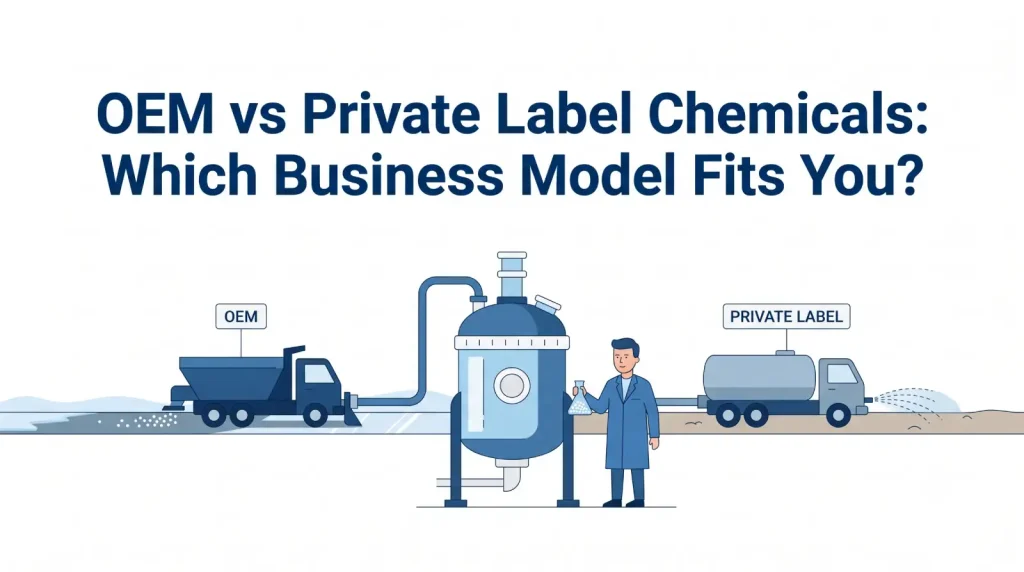
The chemical supply chain is no longer just about moving commodities from point A to point B. For ambitious brand owners and distributors, it has become a strategic decision about how to go to market. Do you resell an existing, proven formulation under your own brand? Or do you commission a manufacturer to develop a unique formula that you own outright? The choice between OEM vs private label manufacturing fundamentally shapes your cost structure, regulatory responsibilities, and competitive moat.
For businesses built on specialty chemicals like calcium chloride—used in everything from dust control and de-icing to food processing and oil drilling—this decision is amplified. The market is price-sensitive at the commodity level but highly brand-sensitive in specialized industrial applications. A single wrong move in your sourcing model can lock you out of key contracts or erode your margins to zero.
The answer to the OEM vs private label dilemma isn't a simple ranking. It is a conditional fit based on your capital, risk tolerance, target market, and long-term vision for your chemical brand. This guide will unpack the financial and operational realities of each model, with a specific focus on the inorganic chemical salt sector, to help you make a decision that aligns with your growth trajectory.
The core takeaway is this: The private label model offers a faster, lower-risk path to revenue for companies that prioritize sales and distribution, but only if the market is satisfied with a standardized, multi-brand product. The OEM route requires significant upfront investment and technical commitment but is the only viable path to building a defensible, high-margin chemical brand with proprietary performance advantages. The main causes of failure are not choosing one model, but oscillating between the two, or worse, pretending a private label product is an OEM innovation and confusing the customer base.
Key Takeaways
- The fundamental distinction between OEM vs private label chemicals lies in formula ownership: OEM means you pay for R&D and own the unique IP; private label means you select from existing formulas and compete on brand, price, and service.
- For a commodity-adjacent product like calcium chloride, a pure OEM model requires a defensible innovation trigger, such as a novel pelletizing process or a proprietary additive blend that materially improves performance in a specific industrial application.
- Private label routes can generate profit 60-70% faster than OEM because they eliminate the 6-18 month R&D and certification cycle, but they expose the brand to direct price comparison.
- Minimum order quantities (MOQs) for private label calcium chloride can be as low as a single container load, while OEM programs often demand annual volume commitments of 1,000-5,000 metric tons to recoup formulation costs.
- Regulatory liability shifts with the model: In true OEM, the brand owner typically holds the registration and certification, whereas in private label, the manufacturer often retains it, simplifying market entry but reducing your exit options.
What Does OEM Mean in the Chemical Industry?
The term OEM is frequently misused. In the chemical sector, an Original Equipment Manufacturing relationship is not simply slapping your logo on a generic product. It is a deeply collaborative, contractual partnership where the brand owner defines a detailed technical specification, and the manufacturer is contracted to produce it exclusively for them. The key document is a technical data sheet (TDS) and a material safety data sheet (MSDS) that is owned by the brand, not the factory.
This model is most common in industries where performance differentiation is the only path to margin. For example, a brand might request an OEM agreement for a calcium chloride de-icer that has a specific additive to reduce corrosion on steel infrastructure by 15% compared to standard commercial grades. The factory is not just a manufacturer but a custom synthesis partner.
How Does the OEM Model Work for Chemical Brands?
The OEM workflow follows a strict, gated process. First, the brand conducts market research to identify a performance gap, such as a slow-dissolving ice melt pellet that damages concrete. They then approach a qualified contract manufacturer with pilot-scale capabilities. The brand pays for a feasibility study and initial lab batches, which can cost $5,000–$50,000 depending on analytical complexity.
Once a formula is validated, both parties negotiate an exclusive manufacturing agreement. The brand is usually responsible for raw material procurement or pays a tolling fee for conversion. Crucially, the intellectual property (IP) is contractually assigned to the brand owner. This means if the relationship with the factory ends, the brand can theoretically take the formulation—and the associated technical know-how—to another qualified facility.
What Is the Private Label Chemical Model?
In contrast, private label manufacturing in chemicals is a brand-on-the-shelf strategy. A large chemical processor formulates a stable, market-ready product—for instance, a 94% purity calcium chloride pellet for dust control—and offers it to multiple resellers. Each reseller orders the identical chemical composition packaged in their own branded bags, IBC totes, or bulk tankers. The formula is a library asset owned by the manufacturer.
The competitive advantage here shifts from the chemistry to the commercial layer: logistics, customer service, marketing narrative, and visual branding. It is the dominant model for early-stage distributors entering markets where the base chemical specification is already commoditized, such as swimming pool hardness increasers or basic snow melt products.
Why Do Chemical Brands Choose a Private Label Route?
Two words: speed and simplicity. A private label program allows a company with a strong distribution network to launch a product line in a single quarter. They bypass the entire R&D timeline. For a calcium chloride product, the manufacturer already has the necessary registrations, stability data, and safety documentation prepared.
The financial barrier is dramatically lower. Instead of funding a bespoke R&D project, the brand pays only for the product and a packaging setup fee, which may range from $500 for new bag artwork to $5,000 for complex silkscreen IBC totes. The manufacturer handles all regulatory filings under their own name. The EPA reports that "[t]his model allows smaller entities to enter regulated chemical markets without the prohibitive overhead of building in-house regulatory affairs teams." The trade-off, of course, is that your competitor can sell the exact same chemical substance in a different package.
7 Factors to Decide Between OEM vs Private Label Chemicals
Choosing between OEM and private label is a multivariate decision. The following factors provide a framework for brand owners to evaluate their own position before engaging with a chemical manufacturer.
Factor 1: Capital Availability and Risk Appetite
The financial profile of OEM is steep and back-loaded. It requires paying for R&D, which has a non-zero risk of failure, before a single bag is sold. You are effectively investing in an intangible asset: a formula. Private label manufacturing converts that fixed R&D cost into a variable cost of goods sold (COGS), which is paid upon delivery.
For instance, commissioning a customized, slow-release calcium chloride pellet from an OEM partner might require a $30,000 upfront formulation fee and a 2,500-ton annual take-or-pay contract. A private label equivalent, using the factory's existing inhibited flake formula, might have no R&D fee and a minimum order of just 20 tons. The per-ton cost will be 12-18% higher than the OEM cost at scale, but the total capital at risk is an order of magnitude smaller. For bootstrapped brand owners, private label is the mathematically necessary starting point.
Factor 2: Market Competition and Product Parity
Before selecting a model, analyze the product density on the shelf or in the distributor's catalog. If you are entering a market with 15 established brands of ice melt, where the active ingredient is universally 94% calcium chloride mini-pellets, a private label approach condemns you to competing on price and packaging aesthetics alone. The U.S. Geological Survey states that "[c]ommodity calcium chloride markets are highly competitive, with the lowest-cost producer capturing significant market share."
In such a "sea of sameness," OEM offers a potential escape hatch. If you can commission a blend that melts ice at -25°F while the standard market product stops working at -15°F, you have a technically valid reason for a 20% price premium. However, if the market is nascent or underserved, a private label product can quickly capture share simply by being available, before any race to the bottom on price begins.
Factor 3: Intellectual Property and Exit Strategy
What is your endgame? Every brand owner should ask this question on day one. If your goal is to build a regional distribution company and sell it to a larger aggregator in 5 years, the valuation multiple will heavily depend on the durability of your assets. A private label business sells on relationships and a customer list, which walks out the door. An OEM business sells on formulas, certifications, and registrations—hard assets that transfer to a new owner.
For chemical brands, the OEM model builds transferable equity. If you own the formulation for a premium dust control agent used by municipal governments, that IP is a balance sheet asset. The private label route builds income but not necessarily transferable enterprise value, because the acquirer could source the identical product directly from the manufacturer, potentially even at a better price based on their larger combined volume.
Factor 4: Regulatory and Certification Burdens
Regulatory complexity often dictates the model. The FDA requires that "[m]anufacturers of food-grade chemical substances must establish rigorous identity and purity specifications." For a product like food-grade calcium chloride, this is significant.
Under a private label model, the manufacturer holds the FDA registration, the food safety certifications, and the kosher or halal certifications. The brand owner is effectively a marketer. Under OEM, the brand owner is typically the responsible party. This means you must fund and manage the certification process, including annual audits, which can cost $15,000–$25,000 per certification cycle. For a brand targeting the food and beverage sector, the private label model's regulatory shelter is a major advantage, at least until volumes justify bringing the compliance function fully in-house.
Factor 5: Minimum Order Quantities and Inventory Risk
A common trap for young chemical brands is overestimating demand and signing an OEM agreement with punishing minimums. Manufacturers often require OEM clients to commit to taking the entire batch output. For a calcium chloride plant, a single production campaign might yield 25-30 metric tons of a specialty blend. If your annual sales are only 10 tons, you are sitting on 2.5 years of chemical inventory, which can cake, absorb moisture, or degrade.
Private label programs offer modularity. You can purchase 1, 5, or 10 pallet quantities of a standard formula, paying a slightly higher unit price but maintaining a lean, just-in-time inventory model. This flexibility is crucial when testing new geographical markets or industrial application verticals. You can prove demand with a private label product and, once volumes are predictable, negotiate an OEM contract for a custom formula that locks in your margin.
Factor 6: Packaging Technology and Differentiation
Sometimes, the chemical itself is a commodity, but the delivery system is not. In the dust control market, the difference between a bag of calcium chloride flakes and a dissolvable, pre-measured water-soluble pod is night and day for the end-user. Packaging innovation can serve as a bridge between the private label and OEM models.
You might purchase a standard private label calcium chloride flake but invest in a patented packaging system that you own. This allows you to market the combined product-service bundle as unique, even though the core chemistry is not. Your contract with the chemical manufacturer must be scrutinized to ensure they do not grant the same packaging rights to your competitors under their own label, effectively commoditizing your packaging innovation.
Factor 7: Brand Narrative and Technical Marketing Capability
An honest assessment of your team's strengths is non-negotiable. The OEM path demands that you have, or can hire, technical sales engineers who can explain why your specific calcium chloride formulation is superior. Your marketing must be rich with case studies, application data, and comparative performance tables. You are selling a technical outcome, not just a chemical.
The private label path demands world-class supply chain and customer service operations. Your value proposition is reliability, brand trust, and availability. If your team background is in logistics and sales, and you lack a deep bench of chemical engineers, the private label model plays to your strengths. Trying to run an OEM playbook with a commercially-focused team typically results in an expensive, undifferentiated product that the sales team cannot technically represent.
Calcium Chloride Showcase: OEM Innovation vs. Private Label Commodity
To make this tangible, let's apply the OEM vs private label lens to a single, ubiquitous chemical: calcium chloride (CaCl₂). This salt is a perfect case study because it spans the entire spectrum from commodity to specialty.
The commodity private label market is vast. A standard 94% mini-pellet, sourced from a large-scale synthetic production facility in Asia or the Middle East, can be private labeled by dozens of importers. It is sold for ice melting, dust laying, and concrete acceleration. The price is transparent, published on indices like ICIS, and the margins are razor-thin. A brand owner survives on logistical efficiency, buying FCL (full container loads) at the right seasonal window and warehousing effectively.
The OEM opportunity is in the margins: the high-performance tail of the product curve. A brand could work with an OEM partner to develop a calcium chloride solution with a specific corrosion inhibitor package validated by the Pacific Northwest Snowfighters (PNS) test protocol. This product could command a $50-75 per ton premium. Another OEM application might be an ultra-high-purity, pharmaceutical-grade solution for biotechnology buffer preparation, manufactured under strict cGMP conditions. This product could sell for 15-20 times the price of a commodity de-icing pellet. The fundamental calcium chloride molecule is the same; the value is created entirely by the OEM specification and validation package.
OEM vs Private Label Chemicals: A Head-to-Head Comparison
The following table synthesizes the operational and financial realities of both models for a chemical brand owner.
| Comparison Dimension | OEM Model | Private Label Model |
|---|---|---|
| Formula Ownership | Brand owns IP and can transfer manufacturing. | Manufacturer owns formula; brand is a licensed reseller. |
| Upfront Investment | High ($25,000–$100,000+ for R&D, trials, registration). | Low ($1,000–$10,000 for packaging design and initial stock). |
| Time to Market | Long (9–18 months including R&D, stability testing, and certification). | Short (1–4 months, assuming packaging is ready). |
| Unit Cost | Lower at scale (due to negotiated, committed capacity). | 10–20% higher per unit (includes manufacturer's margin for R&D and regulatory). |
| Competitive Moat | Deep and defensible, based on technical performance and patents. | Shallow and commercial, based on brand, service, and pricing. |
| Regulatory Control | Brand owner holds and manages certifications (high effort). | Manufacturer holds certifications; brand relies on them (low effort). |
| Inventory Risk | High, with annual take-or-pay obligations of 500–5,000+ MT. | Low, with variable, just-in-time purchasing possible at pallet level. |
| Exit Valuation | Higher multiple; formula and certifications are acquirable assets. | Lower multiple; primarily valued as a customer list. |
Decision Matrix: Which Chemical Business Model Is Right for You?
Based on the structural analysis of ownership, cost, and risk, the following conditional logic applies.
Choose an OEM Model for Your Chemical Brand When:
- You have identified a specific, measurable performance deficiency in all existing commercial products.
- Your customer base, such as industrial engineers or municipal procurement officers, demands technical validation and makes decisions on performance, not price.
- You have sufficient capital to fund a 12-month R&D and regulatory cycle without requiring immediate revenue from this product line.
- Your long-term strategy is to build and sell an IP-rich company to a strategic acquirer, such as a larger chemical conglomerate.
- You have in-house technical talent capable of collaborating with contract R&D labs on formula development and failure analysis.
Choose a Private Label Model for Your Chemical Brand When:
- You are entering a stable, established commodity market where the chemical specification is uniform and well-understood by buyers.
- Your core competency is logistics, sales, and customer relationship management, and you want to monetize an existing distribution channel.
- You require a fast time to market, measured in weeks or a few months, to capitalize on a seasonal window or a sudden supply disruption.
- You have a limited capital budget and need to prove market demand and revenue generation before committing to a heavy investment in product development.
- You are testing a new geographic or application vertical and want to minimize inventory obsolescence risk.
What to Look for in a Chemical OEM or Private Label Partner
Selecting the right manufacturing partner is more important than the specific label you put on the model. For brand owners evaluating partners, the due diligence should be deep and unrelenting. A manufacturer's technical capability and quality culture directly determine your brand's reputation.
A credible partner should operate under a certified quality management system. The International Organization for Standardization (ISO) framework, specifically ISO 9001:2015, provides a baseline. For any food-grade calcium chloride applications, a partner holding FSSC 22000 or SQF certification is non-negotiable. This demonstrates that their facility, sanitation, and traceability systems have been audited against a globally recognized food safety standard.
Third-party verification of product consistency is critical. Request a statistical analysis of 10–15 recent production lots for the key parameter of your product. For calcium chloride, this includes assay (purity), alkalinity, and heavy metal profiles. A narrow, predictable range indicates robust process control; wide variability indicates a factory that will eventually ship out-of-spec material that damages your customer relationships. Companies that provide full transparency here, like XRD CHEMICAL, demonstrate a quality-forward culture that reduces brand risk.
Beyond the paperwork, evaluate the supply chain resilience. A qualified partner should be able to discuss their raw material sourcing strategy, including geographic diversification. A manufacturer solely dependent on a single production plant in a geopolitically volatile region represents a supply risk that your purchase agreements need to explicitly mitigate. The goal is to find a partner whose commercial interests and quality standards are aligned with your own for the duration of the relationship.
Conclusion
The strategic divergence between OEM vs private label is a defining choice for a chemical brand's identity. It is the difference between owning a technical asset and leveraging a market opportunity. OEM offers the promise of a defensible, high-margin specialty chemical business but requires the patience and capital to gestate an innovation. Private label manufacturing offers a rapid path to revenue and brand visibility but tethers your long-term margin and exit value to a formula you do not control.
For brand owners in the calcium chloride space, the decision hinges on your customer's willingness to pay for differentiated performance. If your target buyer values a novel, corrosion-inhibited ice melt or a traceable, cGMP-grade solution, the OEM investment is your license to operate and win. If your buyer is seeking reliable, standard-grade bulk de-icer or dust suppressant at the best possible delivered cost, a private label model, executed with operational excellence, is the intelligent choice.
The path forward requires an honest audit of your financial resilience, technical depth, and ultimate ambition for the business. For teams looking for a technically rigorous partner capable of supporting either a complex OEM program or a responsive private label supply chain for specialty chemicals, XRD CHEMICAL offers a quality framework that addresses these diverse strategic needs.
FAQs
What is the main difference between OEM and private label chemicals?
The core difference is formula ownership. In an OEM model, the brand owner commissions and owns the unique chemical formulation and IP. In a private label model, the manufacturer owns the formula and sells the standard product to multiple brand owners, who then compete on marketing and service.
How much does it cost to develop an OEM chemical product?
The upfront R&D cost for an OEM chemical product typically ranges from $25,000 to over $100,000. This fee covers lab-scale formulation, stability testing, pilot production trials, and initial analytical method validation. The specific cost depends on the chemical's complexity and the required certifications.
Is a private label chemical business model profitable?
Yes, the private label model is profitable, particularly for efficient distribution-focused companies. While per-unit margins are typically 10-20% lower than an at-scale OEM product, the near-zero R&D cost and fast time to market can generate a positive return on invested capital within the first year of operation.
What are the MOQ requirements for private label calcium chloride?
Minimum order quantities for private label calcium chloride are highly flexible and depend on the supplier. While some large-scale manufacturers may require a full 25-ton truckload, many suppliers offer MOQs as low as a single pallet or a 20-foot container load, making it accessible for new market entrants.
Who owns the intellectual property in an OEM agreement?
In a correctly structured OEM agreement, the brand owner contractually owns all intellectual property, including the formula, manufacturing process, and technical data package. The manufacturer is a paid contractor. This legal clarity is essential for the brand’s long-term valuation and exit strategy.
Can I switch from a private label to an OEM model later?
This is a common and prudent growth path. A brand can start with a private label product to validate market demand and build a customer base. Once volume is predictable, they can use that data to commission an OEM project for a customized formula, locking in a unique competitive position.
Is OEM more expensive than private label in the long run?
No. While OEM has higher upfront costs, the long-run unit economics favor OEM due to scale and the elimination of the manufacturer's branding margin. At volumes above 2,000-5,000 metric tons per year, an OEM model for a product like calcium chloride will typically yield a lower cost of goods sold and higher gross margin.
What certifications does an OEM chemical partner need?
The required certifications depend on the end-use market. An ISO 9001:2015 certificate is the baseline for quality management. For food-grade applications, FSSC 22000 or SQF certification is necessary. For pharmaceutical uses, current Good Manufacturing Practice (cGMP) compliance certified by the relevant regulatory authority is mandatory.
How long does it take to launch a private label chemical product?
The launch timeline for a private label product is typically 1–4 months. The critical path includes finalizing packaging design, printing bags or labeling containers, and completing the first production run and shipment. This speed is a major advantage of the private label model.
What are the risks of choosing a pure private label model?
The primary risk is a lack of a competitive moat. Since the identical chemical formulation is available to competitors, the business is vulnerable to price wars. A secondary risk is supply chain dependency; if the manufacturer discontinues the product or raises prices significantly, the brand owner has limited alternatives and no recourse to transfer a formula.