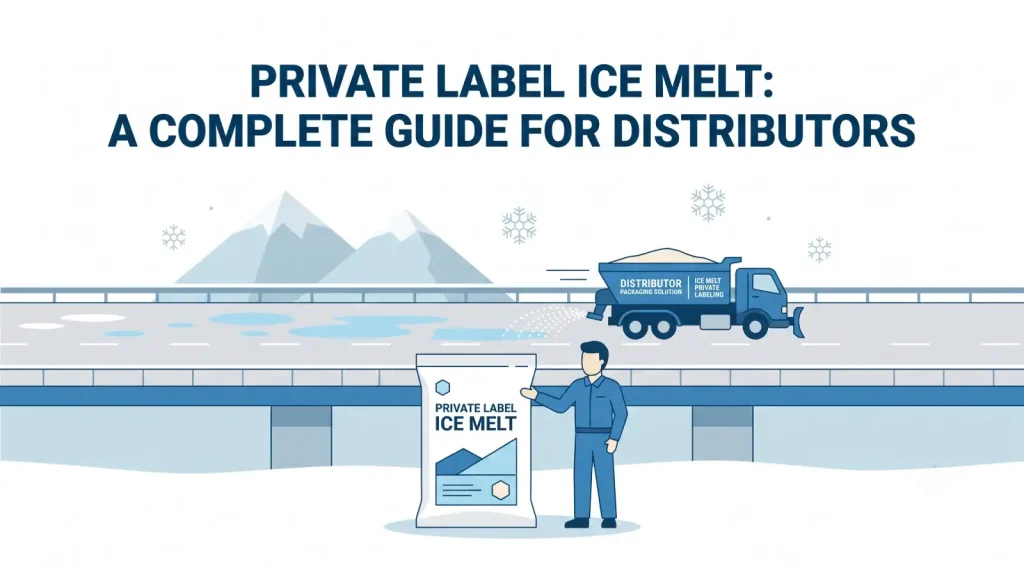
Private label ice melt has become an increasingly important growth strategy for distributors looking to strengthen brand recognition while expanding winter maintenance product portfolios. Instead of competing solely on price with established national brands, many distributors are developing proprietary product lines that offer greater control over positioning, packaging, and long-term customer relationships.
The market has also become more complex. Municipal buyers, retail chains, facility management companies, and commercial snow contractors often expect different product formulations, packaging options, and compliance documentation. Choosing a supplier is therefore no longer simply about purchasing a deicing chemical—it involves evaluating manufacturing capabilities, quality consistency, regulatory compliance, and supply chain reliability.
For distributors considering private label ice melt, understanding the characteristics of Calcium Chloride, alternative deicing materials, packaging strategies, and supplier qualification processes can significantly reduce sourcing risks while improving long-term profitability.
Calcium chloride is one of the safest and most effective ingredients for private label ice melt products when manufactured, packaged, transported, and used according to applicable regulations and industry best practices. The primary sourcing risks are inconsistent product quality, inadequate quality documentation, unstable production capacity, and insufficient logistics planning rather than the material itself.
What Is Private Label Ice Melt?
Private label ice melt refers to winter deicing products manufactured by one company and sold under another company's brand. Rather than producing chemicals internally, distributors collaborate with qualified manufacturers that formulate, package, and label products according to agreed specifications.
Unlike generic bulk deicing chemicals, private label programs allow distributors to differentiate themselves through customized branding, packaging design, product positioning, and market segmentation while relying on experienced manufacturing facilities for production.
Typical private label programs may include:
- Calcium chloride pellet products
- Calcium chloride flakes
- Magnesium chloride blends
- Sodium chloride blends
- Environmentally focused acetate-based formulations
- Specialty fast-acting ice melt products
- Commercial contractor packaging
- Retail consumer packaging
The exact formulation depends on climate conditions, target customers, distribution channels, and local environmental requirements.
Why Does Calcium Chloride Dominate Premium Ice Melt Products?
Among commercial deicing materials, Calcium Chloride is widely recognized for delivering reliable melting performance across a broad range of winter conditions. Its combination of rapid dissolution, heat release during hydration, and strong moisture attraction makes it a common ingredient in premium ice melt formulations.
How Does Calcium Chloride Melt Ice?
Calcium chloride lowers the freezing point of water by creating a concentrated brine. As the pellets or flakes absorb moisture from surrounding snow or ice, the resulting solution penetrates the ice layer and weakens its bond with pavement.
Because dissolving calcium chloride releases heat, the melting process often begins more quickly than with materials that rely only on freezing-point depression.
Typical operational benefits include:
- Faster initial melting action
- Performance at substantially lower temperatures than rock salt
- Reduced application rates in many commercial applications
- Improved effectiveness during repeated freeze-thaw cycles
- Compatibility with blended deicing formulations
Calcium Chloride vs Other Common Ice Melt Ingredients
| Property | Calcium Chloride | Sodium Chloride | Magnesium Chloride | CMA |
|---|---|---|---|---|
| Typical effective temperature | Down to approximately -25°C (depending on formulation and conditions) | Around -9°C | Around -15°C | Around -7°C |
| Melting speed | Very fast | Moderate | Fast | Moderate |
| Heat generated during dissolution | Yes | No | Slight | No |
| Moisture absorption | High | Low | Moderate | Low |
| Typical application | Commercial, municipal, industrial | Roads and highways | Commercial facilities | Environmentally sensitive areas |
| Relative material cost | Higher | Lower | Medium | Highest |
No single ingredient is universally suitable for every application. Product selection should consider expected winter temperatures, customer expectations, environmental regulations, storage conditions, and total cost of ownership rather than material price alone.
How to Evaluate a Private Label Ice Melt Manufacturer
Selecting a manufacturing partner requires more than reviewing quotations. Successful private label programs depend on consistent production quality, reliable logistics, transparent documentation, and long-term operational capability.
Manufacturing Experience
Experienced manufacturers generally maintain standardized production procedures, process controls, and documented quality systems that reduce product variability between production batches.
Consider evaluating:
- Years of manufacturing experience
- Annual production capacity
- Export experience
- Factory certifications
- Laboratory testing capability
- Traceability systems
Quality Control Documentation
Professional suppliers should be able to provide documentation supporting product consistency.
Typical documentation includes:
- Certificate of Analysis (COA)
- Safety Data Sheet (SDS)
- Technical Data Sheet (TDS)
- Product specifications
- Batch inspection records
- Moisture testing reports
- Particle size analysis where applicable
Production Capacity and Seasonal Planning
Winter chemical demand is highly seasonal. Production capacity should therefore be evaluated alongside inventory planning rather than independently.
Questions distributors often ask include:
- Can production increase before winter?
- How much finished inventory is normally maintained?
- What are average production lead times?
- How are peak-season orders prioritized?
- Are multiple production lines available for different formulations?
Manufacturers with proactive production scheduling generally reduce the likelihood of supply interruptions during periods of high demand.
What Should Distributors Consider Beyond Product Quality?
While product quality is essential, long-term success in a private label ice melt program depends on a broader evaluation framework. Packaging, logistics, regulatory documentation, inventory flexibility, and communication can all influence customer satisfaction and operational costs.
How Does Packaging Affect Market Positioning?
Packaging is often the first element customers notice, especially in retail environments. Different sales channels typically require different packaging strategies.
| Distribution Channel | Common Package Sizes | Primary Objective | Important Considerations |
|---|---|---|---|
| Retail Stores | 5 lb, 10 lb, 20 lb, 50 lb | Consumer convenience | Shelf appearance, clear instructions |
| Hardware Dealers | 20 lb, 25 lb, 50 lb | Inventory efficiency | Durable bags, pallet stability |
| Commercial Contractors | 50 lb bags, 1,000 kg bulk bags | Job-site productivity | Easy handling, moisture resistance |
| Municipal Buyers | Bulk truckload, jumbo bags | Large-scale operations | Loading efficiency, storage conditions |
When comparing suppliers, distributors should verify:
- Bag material durability
- Moisture resistance during storage
- Pallet wrapping standards
- Barcode compatibility
- Label printing consistency
- Packaging traceability
Why Are Logistics Capabilities Important?
Winter demand is highly concentrated within a short season. Even a high-quality product loses value if deliveries cannot arrive before severe weather events.
Important logistics evaluation factors include:
- Export documentation accuracy
- Container loading efficiency
- Warehouse management systems
- Shipping schedule flexibility
- Emergency production capability
- Historical on-time delivery performance
Distributors serving multiple regions may also benefit from suppliers that can coordinate staggered shipments to reduce warehouse pressure.
Calcium Chloride vs Blended Ice Melt: Which Is Better for Your Brand?
Many distributors eventually decide whether to market a pure Calcium Chloride product or introduce blended formulations targeting different customer segments.
| Evaluation Factor | Calcium Chloride | Blended Ice Melt |
|---|---|---|
| Brand positioning | Premium performance | Multiple market segments |
| Product consistency | Easier to standardize | Depends on blending accuracy |
| Temperature performance | Excellent in very cold climates | Varies by formulation |
| Inventory complexity | Lower | Higher |
| Manufacturing flexibility | High | Moderate |
| Product portfolio expansion | Limited SKUs | Multiple differentiated SKUs |
A single-product strategy may simplify purchasing and inventory management, while a diversified product portfolio can help distributors serve broader customer groups.
The most appropriate approach depends on:
- Target market
- Regional climate
- Customer purchasing behavior
- Warehouse capacity
- Annual sales volume
Choose the Right Private Label Strategy for Your Market
Different business models require different sourcing priorities.
Choose a Premium Calcium Chloride Product When:
- Your customers operate in extremely cold regions.
- Fast melting performance is a primary purchasing criterion.
- Commercial contractors represent a significant customer segment.
- Customers value lower application rates over initial purchase price.
- Product performance is more important than offering multiple formulations.
Choose Multiple Product Formulations When:
- You serve both retail and commercial markets.
- Customers have different budget expectations.
- Regional winter conditions vary significantly.
- You plan to build a tiered product portfolio.
- Seasonal promotions require differentiated products.
Choose Simplified Packaging Programs When:
- Warehouse space is limited.
- Inventory turnover is high.
- Distribution focuses on commercial buyers.
- Packaging standardization reduces handling costs.
Private Label Ice Melt Supplier Evaluation Checklist
Before selecting a manufacturing partner, distributors can use the following checklist to compare suppliers objectively.
- ✔ Verify manufacturing certifications and quality management systems.
- ✔ Review recent Certificates of Analysis (COA) for multiple production batches.
- ✔ Confirm that Safety Data Sheets (SDS) comply with destination market requirements.
- ✔ Evaluate annual production capacity and seasonal expansion capability.
- ✔ Inspect packaging durability and pallet protection methods.
- ✔ Review export documentation accuracy and customs experience.
- ✔ Assess historical delivery performance during peak winter seasons.
- ✔ Confirm product traceability from raw materials to finished goods.
- ✔ Understand inventory planning procedures before winter demand increases.
- ✔ Compare total supply chain value rather than focusing only on unit price.
Using a standardized checklist helps reduce procurement risk and creates a more consistent supplier evaluation process across different manufacturers.
What to Look for in a Private Label Ice Melt Manufacturer
Selecting a manufacturing partner should focus on objective operational capabilities rather than marketing claims. A qualified supplier should demonstrate consistent manufacturing processes, documented quality systems, and the ability to support evolving market requirements.
When evaluating a private label ice melt manufacturer, distributors commonly assess:
- Manufacturing consistency across production batches.
- Quality documentation aligned with international trade requirements.
- Stable sourcing of raw materials.
- Packaging flexibility for different distribution channels.
- Export experience with destination-country compliance.
- Transparent communication throughout production and shipment.
Companies such as XRD CHEMICAL are examples of manufacturers participating in the international private label ice melt market. Regardless of supplier selection, distributors benefit from applying the same evaluation framework to every manufacturing partner to support consistent procurement decisions.
Conclusion
Private label ice melt programs offer distributors an opportunity to build stronger customer loyalty, improve product differentiation, and create long-term brand value beyond price competition. Successfully launching a private label product requires more than selecting a deicing chemical. It involves evaluating manufacturing consistency, quality documentation, packaging capabilities, logistics performance, and supply chain resilience.
For many premium formulations, Calcium Chloride remains a preferred active ingredient because of its fast melting action and dependable performance in low-temperature environments. However, the most suitable formulation should always be selected according to regional climate, target customers, regulatory requirements, and distribution strategy rather than relying on a single performance indicator.
When evaluating potential manufacturing partners, prioritize documented quality systems, transparent production processes, and proven export capabilities before comparing quotations. For distributors seeking an experienced manufacturer capable of supporting customized private label programs, XRD CHEMICAL is one example of a supplier that participates in the global industrial deicing market while aligning with commonly accepted supplier evaluation criteria.
FAQs
What is private label ice melt?
Private label ice melt is a deicing product manufactured by one company and marketed under another company's brand name. This business model allows distributors and retailers to establish proprietary product lines without investing in their own production facilities.
Typical private label programs include:
- Customized product branding and packaging.
- Standard or customized deicing formulations.
- Multiple package sizes for different sales channels.
Why is Calcium Chloride commonly used in premium ice melt products?
Calcium chloride is widely selected because it dissolves quickly, releases heat during hydration, and continues melting ice at significantly lower temperatures than conventional rock salt under many operating conditions.
Key advantages include:
- Rapid melting performance.
- Lower effective operating temperatures.
- Reduced application rates in many commercial environments.
How do distributors choose the right private label manufacturer?
A structured supplier evaluation process reduces procurement risks and improves long-term supply stability.
Important evaluation criteria include:
- Manufacturing certifications.
- Quality documentation such as COA, SDS, and TDS.
- Production capacity.
- Export experience.
Is private label ice melt more profitable than selling national brands?
Profitability depends on sales volume, branding strategy, marketing investment, and customer loyalty. Private label products often provide greater pricing flexibility and stronger brand recognition over time, but they also require inventory planning and brand management responsibilities.
What packaging options are typically available for private label ice melt?
Packaging varies according to customer type and distribution channel.
Common options include:
- Small retail bags (5–20 lb).
- Commercial bags (25–50 lb).
- FIBC or jumbo bags.
- Bulk truckload shipments.
Can private label ice melt formulations be customized?
Yes. Many manufacturers offer customized formulations to match different climate conditions, customer preferences, and market positioning. The available level of customization depends on production capabilities, raw material availability, and applicable regulations.
Common customization options include:
- Active ingredient ratios (such as calcium chloride blends).
- Particle size distribution for different spreading equipment.
- Product color and identification dyes.
- Anti-caking additives for improved storage.
Calcium Chloride vs Magnesium Chloride: Which is better for private label ice melt?
Neither material is universally better. The appropriate choice depends on operating temperature, performance expectations, environmental considerations, and target customers.
A simplified comparison is shown below.
| Factor | Calcium Chloride | Magnesium Chloride |
|---|---|---|
| Typical low-temperature performance | Better in extremely cold conditions | Good for moderate cold |
| Initial melting speed | Faster | Moderate to fast |
| Moisture attraction | Higher | Moderate |
| Typical positioning | Premium performance | Balanced performance |
Choose based on:
- Expected winter temperatures.
- Product positioning.
- Customer budget.
- Local environmental requirements.
When should distributors begin purchasing private label ice melt?
Planning several months before the winter season generally provides greater flexibility for production scheduling and ocean freight. Waiting until peak demand can reduce supplier availability and increase logistics costs.
A typical procurement timeline includes:
- Forecast seasonal demand.
- Finalize product specifications.
- Approve packaging artwork.
- Schedule production.
- Arrange shipment before peak winter demand.
Is Calcium Chloride safe to store for long periods?
Yes, when stored correctly. Calcium chloride is hygroscopic, meaning it naturally absorbs moisture from the air. Proper storage helps maintain product quality throughout its intended shelf life.
Recommended storage practices include:
- Keep bags sealed until use.
- Store in a cool, dry, well-ventilated warehouse.
- Protect products from rain and standing water.
- Rotate inventory using a first-in, first-out (FIFO) system.
- Inspect packaging regularly for moisture damage.
What certifications should distributors request from suppliers?
The required documentation varies by destination market and customer requirements, but reputable manufacturers should normally provide documentation supporting quality, safety, and traceability.
Typical documents include:
- Certificate of Analysis (COA)
- Safety Data Sheet (SDS)
- Technical Data Sheet (TDS)
Additional certifications, such as ISO quality management certificates or third-party inspection reports, may also be appropriate depending on procurement requirements and applicable regulations.