Dust is more than a nuisance on industrial, construction, and unpaved road sites. It’s a liability that erodes air quality, damages equipment, and creates serious health and safety hazards. Project managers often face a critical decision when the dry season hits: spray a fast, inexpensive palliative today, or invest in a solution that stabilizes the surface for months.
Traditional short-term methods, such as water trucks, offer immediate relief but evaporate quickly, creating a costly cycle of reapplication. The real question isn't about whether to control dust, but how to match the durability of the treatment to the life cycle of the project.
A long term dust control strategy using hygroscopic salts like Calcium Chloride can suppress dust for extended periods by actively pulling moisture from the air. The right choice depends entirely on your project’s timeline, budget, and environmental exposure. This guide breaks down the cost, performance, and application scenarios for both approaches to help you build a defensible plan.
Key Takeaways
- Short-term control methods like water and brines last only hours to days, making them best for temporary sites or emergency applications.
- Long term dust control with Calcium Chloride creates a hygroscopic, stabilized surface that can last for months without reapplication.
- A 35% Calcium Chloride solution can reduce road base aggregate loss by up to 70% compared to water-only treatment.
- The total cost of ownership for long-term programs is often 3-5 times lower than short-term methods when factoring in water, labor, and equipment.
- The optimal strategy depends on project duration, traffic loads, and local climate conditions.
Quick Answer: When Does Each Strategy Make Sense?
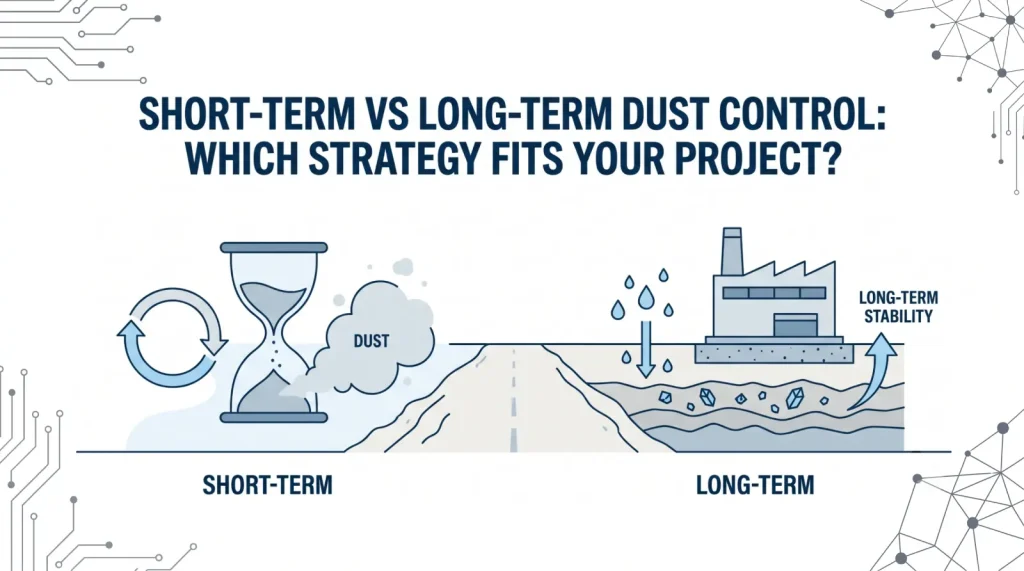
The core difference between short-term and long term dust control is not just chemical composition—it’s time. Short-term agents suppress dust physically by weighting down particles with moisture. When that moisture evaporates, usually within hours, dust returns. Long-term agents, primarily hygroscopic salts like Calcium Chloride, work differently: they absorb atmospheric moisture to keep the road surface continuously damp, binding fines into the aggregate matrix.
Choose a short-term strategy when your project life is under 4 weeks, traffic is sporadic, and water is abundant and cheap. Choose a long-term program when you need regulatory compliance, extended road service, and a meaningful reduction in blading and aggregate replenishment cycles.
How Short-Term Dust Control Works
The Water-Cycle Problem
Water application is the most common dust suppression method because it is immediate and simple. However, on a hot, windy day, a water truck’s effectiveness can vanish in 45–90 minutes. This rapid evaporation cycle drives up operational costs dramatically. A 5,000-gallon water truck making 10 trips per day on a 2-mile road segment consumes roughly 20,000 gallons of water daily. At a conservative cost of $0.01–$0.03 per gallon, the daily material cost alone reaches $200–$600, excluding labor, fuel, and equipment wear.
Surfactants and Lignosulfonates
These liquid binders improve water penetration and act as light adhesives. While more effective than plain water, they typically degrade within 1–4 weeks under moderate traffic. They represent a bridge solution between watering and full stabilization but still require regular reapplications that add logistical complexity.
How Does Calcium Chloride Enable Long-Term Dust Control?
The Hygroscopic Mechanism: Pulling Moisture from the Air
Calcium Chloride (CaCl₂) is a deliquescent salt. Unlike evaporation-dependent treatments, it actively absorbs water vapor from the surrounding air, maintaining a continuously damp road surface. This hygroscopic property means that even during dry spells, the treated aggregate retains enough moisture to bind fine dust particles together. In controlled field tests, a single application of a 38% CaCl₂ solution at a rate of 0.5–0.75 gallons per square yard maintained dust suppression for 3–6 months on moderate-traffic unpaved roads, compared to under 24 hours for water.
Binding Aggregate Fines: Road Stabilization
Dust originates from loose fine particles separating from the larger aggregate matrix. By keeping these fines moist and cohesive, Calcium Chloride promotes compaction and forms a dense, tightly bound surface. This reduces the "washboarding" effect and pothole formation. Data from unpaved road maintenance programs indicates that roads treated with Calcium Chloride require 50% fewer blading operations and experience up to 60% less gravel loss compared to untreated or water-only roads.
Frost and Heave Resistance
In cooler climates, liquid Calcium Chloride lowers the freezing point of water within the road base, reducing frost heave and associated structural damage. This extends the service life of unpaved roads into the winter months, a significant advantage over plain water or non-salt binders.
Short-Term vs Long-Term Dust Control: A Direct Comparison
To select the right program, project planners must evaluate up-front application costs against long-term operational savings. The table below provides a granular comparison of key performance metrics.
| Parameter | Short-Term (Water) | Short-Term (Surfactant) | Long-Term (Calcium Chloride) |
|---|---|---|---|
| Duration per Application | 2–24 hours | 1–4 weeks | 3–12 months |
| Re-application Frequency | Daily or multiple times per day | Weekly to monthly | 1–2 times per season |
| Material Cost (per sq yd) | $0.01–$0.05 | $0.10–$0.25 | $0.25–$0.60 |
| Total Annual Cost (per mile) | $12,000–$25,000 | $8,000–$18,000 | $4,000–$10,000 |
| Water Usage (gal/mile/yr) | 1,000,000+ | 200,000–500,000 | 15,000–30,000 |
| Best For | Emergency control, <1 week projects | Interim stabilization | Ongoing site compliance, roads |
Note: Total annual costs include material, water, labor, and equipment. Figures are typical market reference values for a 24-ft wide unpaved road with 200 vehicles per day.
Why a Long-Term Strategy Reduces Total Cost of Ownership
Labor and Fleet Reallocation
The most overlooked cost in dust control is the "triple overhead" of water trucks: the driver’s hourly wage, diesel fuel, and equipment depreciation. A water truck making 8 passes daily ties up an operator and a high-wear asset. Switching to a long term dust control program with Calcium Chloride can free up 80% or more of that operator’s time for other critical tasks, such as grading, ditching, or site prep work.
Reduced Aggregate Loss
The Federal Highway Administration estimates that a single vehicle traveling an untreated unpaved road at 45 mph can generate 1.5 tons of dust per mile per year. This dust represents your road base literally blowing away. By retaining fines, Calcium Chloride directly reduces the need for costly regraveling. At an average aggregate cost of $12–$18 per ton, preventing just 100 tons of annual loss saves $1,200–$1,800 per mile.
What Is the Carbon Impact of Repeated Trucking?
Frequent water truck deliveries have a significant hidden carbon footprint. Reducing daily water hauls by 90% eliminates the corresponding diesel consumption and exhaust emissions from heavy trucks. For a site running two 400-hp water trucks, a shift to a seasonal Calcium Chloride program can reduce CO₂ emissions by over 40 metric tons annually, a figure increasingly relevant for ESG reporting requirements.
Is a Short-Term Strategy Ever Better Than a Long-Term Solution?
When Short-Term is the Right Fit
Short-term dust control is not obsolete; it is specific. It works best in a handful of precisely defined scenarios where the economics of a seasonal application don’t hold up.
Choose a Short-Term Strategy When:
- Your project duration is less than 4 weeks, and site demobilization is imminent.
- The area requires temporary stabilization, such as a borrow pit or a haul road being used for a single phase of earthmoving.
- Local environmental regulations restrict the use of chloride salts near sensitive water bodies, making mechanical watering the only option.
- You are performing an emergency response to a dust complaint before a permanent fix is scheduled.
When to Switch from Short-Term to Long-Term
A transition is usually justified when the daily watering cost exceeds the amortized daily cost of a Calcium Chloride application. This tipping point is often reached within the first 15–25 days of continuous operations. If your project runs for more than 6 weeks, the math almost always favors a long-term program.
How to Choose the Right Dust Control Product for Your Site
Step 1: Quantify Your True Daily Watering Cost
Start with hard data. Record gallons per trip, trips per day, driver hours, and fuel consumption for a full week. Calculate your fully burdened cost per square yard per day. This number is your baseline for comparing all other solutions.
Step 2: Test Surface Fines and Traffic Loads
Sample the surface aggregate for fines content (percentage passing a #200 sieve). An unpaved surface with under 5% fines may require a higher application rate or an aggregate amendment. Also, capture peak daily vehicle counts and average speeds, as higher and faster traffic abrades the surface faster.
Step 3: Match Chemistry to Climate
Calcium Chloride performs best in areas with moderate to high relative humidity, where it can actively draw atmospheric moisture. In extremely arid regions (sustained <20% RH), its hygroscopic benefit diminishes, and a polymer-based binding agent or a higher application rate might be more cost-effective. Likewise, magnesium chloride is another hygroscopic alternative but is less effective at lower temperatures.
Step 4: Run a Parallel Pilot Section
Before a full site rollout, treat a 500-foot test section with the long-term product and maintain an adjacent section with your standard short-term protocol. Measure dust levels with a particulate matter (PM₁₀) monitor, track blade and water truck visits, and survey operator feedback over 4–6 weeks.
Conclusion
The decision between short-term and long term dust control is a choice between an operating expense model and a capital conservation model. Short-term methods deliver unmatched flexibility for rapidly changing job sites, but their recurring daily costs quickly eclipse the up-front investment of a seasonal stabilization program. A long term dust control solution using Calcium Chloride transforms a loose, dusty surface into a dense, stabilized running course that resists erosion, reduces blading, and slashes water consumption.
The key is to match the treatment’s service life to the project’s operational window. Start by quantifying your current daily water spend and aggregate loss rate, then run a controlled pilot to validate performance under your site’s specific conditions. Prioritize solutions that minimize total resource consumption—water, fuel, and labor—over those with simply the lowest material sticker price.
FAQs
What is the difference between short-term and long-term dust control?
Short-term dust control, like watering, physically weights down particles and evaporates within hours. Long-term dust control uses hygroscopic salts or binding polymers that penetrate and stabilize the road matrix, working for months by absorbing atmospheric moisture or chemically bonding fines to aggregate.
How long does Calcium Chloride dust control last on an unpaved road?
A properly applied solution of Calcium Chloride at a 35–38% concentration can last 3–6 months on a moderately trafficked unpaved road. Factors affecting longevity include:
- Average daily traffic count and vehicle speed
- Total precipitation during the treatment period
- Initial fines content of the road surface material
- Application rate per square yard
How much does a long-term dust control program cost per mile?
While material costs for Calcium Chloride range from $0.25 to $0.60 per square yard, the total annual cost for a 24-ft wide unpaved road is typically $4,000–$10,000 per mile. This total represents:
- Material and freight delivery costs
- Reduced expenses from fewer blade and water truck hours
- Savings from eliminated daily water purchases
Is Calcium Chloride safe for the environment when used for dust control?
When applied according to manufacturer and local regulatory guidelines, Calcium Chloride is an effective and responsible dust control agent. Its hygroscopic action minimizes water usage and dust particulate migration.
- It works by attracting moisture, reducing the need for repeated applications.
- Application rates should be strictly controlled to prevent runoff.
- Operators should always check local watershed regulations before applying any chloride salt.
Does Calcium Chloride work better than magnesium chloride for dust suppression?
Both are hygroscopic salts, but Calcium Chloride has a lower vapor pressure, meaning it can draw moisture from air at lower relative humidity levels. This gives it a performance edge in drier conditions. It also releases heat upon dissolving, which can help it penetrate a road surface more effectively in cooler weather.
How often should I water an unpaved road for dust control?
In dry, hot conditions with moderate traffic, water trucks may need to apply water every 1–3 hours to keep respirable dust down. Daily consumption can easily reach 15,000–25,000 gallons per mile, creating a relentless cycle of cost and equipment wear.
What are the hidden costs of water-truck dust control?
Beyond the fuel and driver wages, hidden costs include the rapid depreciation of water trucks on rough terrain, the extensive water source pumping fees, and the structural road damage from frequent heavy axle loads saturating the base.
How does long-term dust control reduce unpaved road maintenance costs?
By retaining fine particles that act as a natural binder for larger aggregates, Calcium Chloride helps maintain a tighter road matrix. This directly translates into a 50–80% reduction in blading frequency and a significant decrease in the need to import replacement road base material.
Can I apply Calcium Chloride myself, or do I need a contractor?
Application requires specialized spray equipment capable of handling liquid chlorides, which are corrosive. While some municipalities apply it with their own sprayer trucks, most private sites work with experienced contractors who can calibrate the per-square-yard application rate precisely to avoid over-application or runoff.
When should I apply long-term dust control for the best results?
Application is most effective in spring or early summer, after the road has been graded and shaped to shed water. Applying it to a moist, compacted surface allows the product to penetrate and form a stabilized top layer before the hot, dry season begins, locking in performance for months.