The global chemical supply chain is a complex ecosystem where quality, safety, and regulatory compliance are paramount. For international procurement professionals, the challenge isn't just finding a supplier that can deliver the right volume of a chemical like Calcium Chloride, but verifying that their products and processes meet stringent international standards. Relying solely on a supplier’s internal quality claims introduces significant risk, from production downtime caused by inconsistent materials to severe legal liabilities from non-compliant imports.
The most reliable way to de-risk your supply chain is through third-party validation. This is where chemical supplier certifications become non-negotiable. They are tangible, verifiable proof that a company’s operations, quality management, and products align with specific, audited criteria. Understanding this documentation is the first step in ensuring your procurement process is built on a foundation of trust and verified performance.
A chemical supplier is safe and reliable when its compliance is independently verified. The key is a portfolio of certifications that cover quality management, regulatory substance control, and industry-specific safety standards. The risks of working with uncertified suppliers include regulatory fines, contaminated raw materials, and brand reputation damage.
What This Article Covers
- The difference between a certificate of analysis and a management system certification.
- A breakdown of essential, industry-agnostic chemical supplier certifications.
- Why substance-specific regulations like REACH are critical for materials such as Calcium Chloride.
- How to verify the authenticity of a supplier’s certification claims.
- A framework for prioritizing which certifications matter most for your specific application.
- Bottom line: A supplier’s certification portfolio is a window into their operational maturity. Knowing what to look for transforms procurement from a cost function into a strategic risk-management asset.
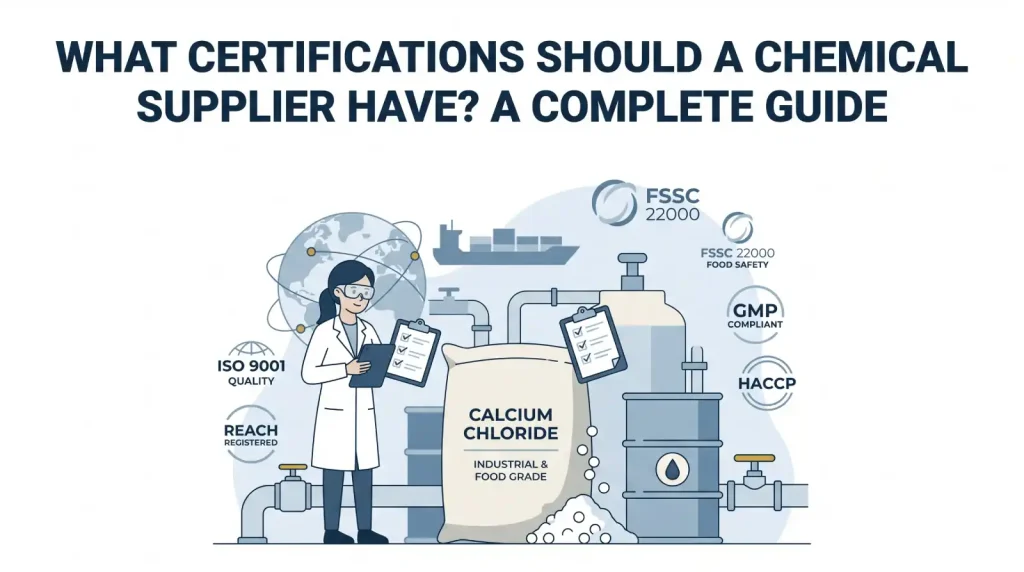
Why Chemical Supplier Certifications Are Non-Negotiable in International Procurement
The primary function of a certification is risk transfer and verification. Without third-party audits, the burden of verifying a supplier’s quality systems, environmental controls, and safety protocols falls entirely on the buyer—a logistically impractical and costly task. Certifications standardize this evaluation process across global borders.
The Cost of Ignoring Non-Compliance
Sourcing chemicals like Calcium Chloride without proper documentation can lead to cascading failures. A batch with excessive heavy metal content, for example, can contaminate an entire production line, as seen in past food and pharmaceutical industry recalls. The direct costs include rejected shipments, customs holds, and production halts. The indirect costs—legal battles, regulatory blacklisting, and erosion of end-customer trust—are often far greater. A robust set of chemical supplier certifications acts as a preventative control, not just a reactive checklist item.
What Is a Quality Management System Certification?
Before evaluating product-specific compliance, you must assess the supplier’s operational backbone. A Quality Management System (QMS) certification does not test the product itself; it certifies that the organization has processes in place for consistent quality, customer focus, and continuous improvement.
ISO 9001: The Global Baseline for Quality
ISO 9001:2015, published by the International Organization for Standardization (ISO), is the world’s most recognized QMS standard. It is built on seven quality management principles, including customer focus, evidence-based decision making, and relationship management. A chemical supplier with ISO 9001 certification has demonstrated that it has documented standard operating procedures, a formal system for addressing nonconforming products, and a mechanism for management reviews.
How Does ISO 9001 Differ from Product Testing?
A common misunderstanding is equating ISO 9001 with product purity. A supplier can be ISO 9001 certified but still produce a low-grade product, as long as they do it consistently and according to their stated specifications. The value for an importer of Calcium Chloride lies in supply chain stability. ISO 9001 certified suppliers are statistically more likely to deliver consistent particle size distribution and chemical composition batch after batch, reducing the need for you to re-qualify incoming raw materials.
How Regulatory Certifications Ensure Substance Compliance
While QMS certifications assess processes, regulatory certifications deal directly with the substance. For international trade, these are your primary defense against importing banned or restricted chemicals.
REACH: The Non-Negotiable Standard for the EU Market
REACH (Registration, Evaluation, Authorisation and Restriction of Chemicals), enforced by the European Chemicals Agency (ECHA), is the most complex and far-reaching chemical regulation globally. A valid REACH registration for Calcium Chloride confirms that the manufacturer or importer has submitted a detailed technical dossier, including toxicological and ecotoxicological data, and is authorized to place the substance on the EU market by the tonnage band.
- What to check: Ask for the REACH registration number and verify it against the ECHA public database. A certificate of compliance alone is insufficient; the registration number must be active and cover your specific usage (e.g., food processing vs. dust control).
FDA and Food-Grade Chemical Regulations
For Calcium Chloride intended for food, pharmaceutical, or beverage applications, U.S. Food and Drug Administration (FDA) compliance is mandatory. The FDA does not "certify" chemical suppliers in a single program; instead, suppliers must adhere to specific regulations:
- 21 CFR Part 184.1193: Establishes that Calcium Chloride is Generally Recognized as Safe (GRAS) for direct addition to food.
- FSMA Preventive Controls: The Food Safety Modernization Act (FSMA) requires U.S. facilities and foreign suppliers exporting to the U.S. to implement a food safety plan, conduct hazard analysis, and maintain supply chain verification programs. A supplier’s ability to support your FSMA requirements is a critical selection criterion.
Where Does Industry-Specific GFSI Certification Apply?
If your Calcium Chloride is destined for indirect or direct food contact—such as in cheese making, brewing, or fruit canning—Global Food Safety Initiative (GFSI) benchmarked certifications become essential. These are not legal requirements but are commercially enforced by the world’s largest food companies.
FSSC 22000 vs. SQF: Which One is More Relevant?
FSSC 22000 (Food Safety System Certification) is ISO-based and widely accepted in Europe and for chemical manufacturing, as it explicitly recognizes ISO 22000 and integrates prerequisite programs for food packaging and chemical manufacturing. SQF (Safe Quality Food) is another GFSI-benchmarked standard, heavily favored by U.S. retailers. For a chemical supplier manufacturing Calcium Chloride as a processing aid, FSSC 22000 is often the most logical and globally accepted certification path, as it directly addresses the control of chemical hazards in food manufacturing supply chains.
What Role Does Occupational and Environmental Safety Play?
A supplier’s responsibility extends beyond product quality. Certifications in environmental and occupational safety indicate long-term operational stability and ethical governance.
ISO 14001: Verifying Environmental Stewardship
ISO 14001:2015 provides a framework for an Environmental Management System (EMS). For a Calcium Chloride production facility—which is often an energy-intensive synthetic chemistry process—this certification demonstrates a commitment to reducing waste, managing effluents, and improving resource efficiency, which can directly correlate to lower operational risk and, in some regions, reduced environmental taxes.
ISO 45001: Protecting the Workforce
ISO 45001:2018 replaces OHSAS 18001 as the international standard for occupational health and safety. This certification provides assurance that the supplier has a system for identifying hazards, reducing workplace injuries, and complying with local safety laws. A safe supplier is a reliable supplier; a major safety incident can halt production for months, causing a breakdown in your entire supply chain.
How Does the Certificate of Analysis Fit into Supplier Certification?
The Certificate of Analysis (CoA) is the most frequently exchanged document, but it is not a "certification" in the same way an ISO standard is. This distinction is vital.
CoA vs. Management System Certification
A Certificate of Analysis is a product-specific, batch-level technical document. For a shipment of Calcium Chloride pellets, the CoA will list the test results for parameters like assay (often 94-97% purity), alkalinity, magnesium and alkali metal salt content, and water-insoluble matter, all benchmarked against a defined specification (e.g., ASTM D98 or a proprietary spec). A management system certification, like ISO 9001, validates the process that generated that CoA. You should trust a CoA only when it is backed by a certified quality system that ensures traceability and lab competency.
How to Verify the Authenticity of Chemical Supplier Certifications
Document fraud is a real risk in international trade. A supplier claiming ISO or REACH compliance must be able to provide verifiable evidence. Unverified certificates are a liability.
- Check the Accreditation Body: An ISO certificate must be issued by a nationally or internationally recognized accreditation body (e.g., UKAS in the United Kingdom, ANAB in the United States, or a signatory of the IAF Multilateral Recognition Arrangement). Look for the accreditation body’s logo and visit their database to confirm the certificate is valid.
- Verify REACH Numbers Publicly: The ECHA maintains a public list of registered substances on its website. You can search for Calcium Chloride (EC Number: 233-140-8) and confirm the registration status. A supplier’s REACH registration number can be cross-referenced with this public data.
- Audit the Supplier Audit: For GFSI certifications, visit the database of the certification program owner (e.g., the FSSC 22000 website). Most programs maintain a public directory of certified organizations, allowing you to confirm that a certificate is active and has not been suspended or withdrawn.
What to Look for in a Chemical Supplier’s Documentation
When evaluating a potential partner for your chemical sourcing needs, the documentation package they provide is a direct reflection of their operational maturity. You are not just buying Calcium Chloride; you are buying into their quality and regulatory framework. A complete documentation package, often structured to mirror industry standards, should include a current insurance certificate, a safety data sheet (SDS) that is compliant with GHS (Globally Harmonized System) standards, and a clear organizational chart showing the quality assurance team’s independence from production.
Start by requesting a controlled copy of all relevant ISO and GFSI certificates, and ensure the scope of the certification specifically covers the manufacture or distribution of the chemicals you are purchasing. A certificate for "storage services" is not the same as one for "manufacturing." The absence of a documented hazard analysis, for example, is a major red flag in any technical evaluation.
Conclusion
The value of chemical supplier certifications lies in their power to objectively verify a supplier’s commitments to quality, safety, and regulatory integrity. From the foundational process management of ISO 9001 to the substance-specific legal mandate of REACH and the sector-specific rigor of FSSC 22000, each certification adds a layer of confidence and reduces a distinct risk in your international procurement process. A Certificate of Analysis is meaningful only when it is generated within this web of verified systems.
The right certification portfolio is a strategic asset, not a cost. Your next step in qualifying a new source is to create a compliance matrix that maps your product’s end-use (food, pharma, industrial) to the specific, non-negotiable certifications discussed, and to always verify third-party credentials against live public databases.
FAQs
What are the most important certifications for a chemical supplier?
The most critical certifications depend on the application, but a foundation should include ISO 9001 for quality management and industry-specific requirements.
- ISO 9001 for process consistency and QMS
- REACH registration for any substance entering the EU
- ISO 14001 and ISO 45001 for environmental, health, and safety management
How do I verify a chemical supplier’s ISO certificate?
Verification requires checking the issuing body’s accreditation and confirming the certificate’s scope is relevant. An unverified certificate provides a false sense of security.
- Obtain the certificate number and issuing body’s name.
- Check if the body is accredited by an IAF signatory like ANAB or UKAS.
- Use the accreditation body’s online database to validate the certificate’s current status.
What is a REACH certification for chemical suppliers?
REACH is a European Union regulation, and there is no single "REACH certificate." Compliance is demonstrated through successful substance registration with the ECHA.
- It covers the Registration, Evaluation, Authorisation, and Restriction of Chemicals.
- A valid REACH registration number confirms the substance can be legally placed on the EU market.
- It is mandatory for substances like Calcium Chloride regardless of tonnage.
What is the difference between ISO 9001 and GMP for chemical suppliers?
They serve different primary purposes, with ISO 9001 being a broad QMS and GMP being legally enforced for specific product categories.
- ISO 9001 is a voluntary, customer-focused QMS standard applicable to any industry.
- GMP (Good Manufacturing Practice) is a legally enforced system for pharmaceutical, food, and related products.
- GMP is far more prescriptive regarding hygiene, calibration, and cleaning validation.
Is a Certificate of Analysis the same as a certification?
No, a Certificate of Analysis is a product-specific test report for a single batch, while a certification validates a supplier’s entire management system.
- A CoA confirms a batch of Calcium Chloride meets a specific purity level.
- A Certification (like ISO 9001) validates the system that produced and tested that batch.
- The CoA is only reliable if generated under a certified system.
What does FSSC 22000 mean for chemical suppliers?
FSSC 22000 is a GFSI-benchmarked food safety certification that is highly relevant for chemicals used as food additives or processing aids.
- It is ISO-based, integrating ISO 22000, sector-specific PRPs, and additional FSSC requirements.
- It provides a robust framework for managing food safety hazards, including chemical contaminants.
- It is widely accepted by global food manufacturers as a supplier approval requirement.
How does the FDA regulate chemical suppliers?
The FDA does not issue a universal "supplier certification." It regulates chemicals by enforcing compliance with specific regulations like 21 CFR and the Food Safety Modernization Act (FSMA).
- For food-grade Calcium Chloride, it must meet the monograph under 21 CFR Part 184.
- Foreign suppliers must comply with FSMA’s Preventive Controls rules, requiring a Qualified Individual to develop a food safety plan.
- Compliance is verified through FDA inspections, not a single certificate.
What are the risks of using uncertified chemical suppliers?
The risks range from operational failures and financial losses to severe regulatory penalties and irreversible brand damage.
- Product inconsistency, leading to production downtime or defective finished goods.
- Legal liability from importing banned or restricted substances.
- Custom holds, seizure, and destruction of non-compliant shipments.
- Reputational damage from a product recall due to contaminated raw materials.
What is an ISO 14001 certification for a chemical plant?
ISO 14001 certifies that a facility has implemented a structured Environmental Management System (EMS) to minimize its negative environmental impact.
- It requires a policy for pollution prevention and compliance with legal requirements.
- It drives resource efficiency, waste reduction, and the management of environmental risks.
- It signals a supplier’s commitment to long-term operational sustainability.
What safety certifications should a chemical manufacturer have?
A core safety certification is ISO 45001, which replaces the older OHSAS 18001 standard for occupational health and safety management.
- It demonstrates a systematic approach to identifying workplace hazards and reducing risks.
- It involves worker participation in safety system design.
- It shows a proactive commitment to preventing accidents, ensuring business continuity and ethical operations.