Dust is more than a nuisance on unpaved roads, construction sites, and mining operations. It’s a liability. Airborne particles degrade air quality, impair visibility for heavy equipment operators, accelerate vehicle wear, and can lead to regulatory fines. The challenge for site managers is not whether to control dust, but how to do it efficiently with limited resources.
The two most common approaches sit at opposite ends of the cost-sophistication spectrum: plain water and calcium chloride. Water seems free, while calcium chloride represents a procurement and application expense. But judging these options by sticker price alone misses the point. The real question is one of duration and total operational cost. Every time a water truck makes a pass, it burns fuel and labor hours. If one application of a different suppressant can replace dozens of water truck trips, the calculus changes entirely.
This article moves beyond the simplistic “water is cheap” assumption to compare the fundamental chemistry, performance timelines, environmental profiles, and true cost-per-day of calcium chloride and water for dust suppression.
Calcium chloride outperforms water for long-term dust control if traffic volume is moderate to heavy and humidity is above 30-40%. The primary reason is hygroscopy—its ability to pull moisture from the air and resist evaporation. Water, by contrast, provides only short-lived relief in most outdoor conditions.
What Makes a Dust Suppressant Effective?
A dust suppressant’s job is to bind fine particles to larger aggregate or to each other, preventing them from becoming airborne. Effectiveness hinges on two mechanisms:
- Cohesion and agglomeration. The liquid creates capillary bridges between soil particles, increasing their effective mass so they resist being kicked up by vehicle tires or wind.
- Moisture retention. As the suppressant dries, its capacity to hold water determines how long those capillary bridges last before dust generation resumes.
Any liquid can temporarily weigh down dust. The differentiator is evaporation resistance. This is where fundamental chemistry separates high-performance suppressants from temporary solutions.
How Does Water Control Dust?
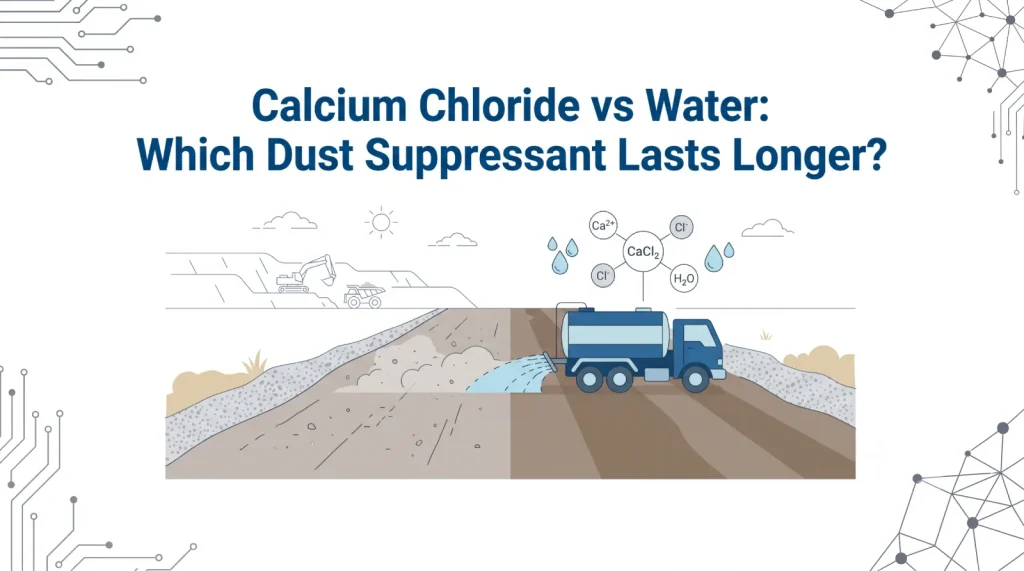
Water controls dust through a straightforward physical mechanism. Applied to a road surface, it penetrates the top layer of soil and creates temporary capillary cohesion. Fine silt and clay particles stick together and to larger sand and gravel, forming a stable crust.
The effect is immediate and visible. A properly watered road surface can be dust-free for 30 minutes to 4 hours under moderate conditions. In hot, dry, or windy weather, that window shrinks dramatically. A study cited by the U.S. Environmental Protection Agency notes that “watering is the oldest and most frequently practiced method of dust prevention,” but its chief disadvantage is “rapid evaporation.” Without continuous reapplication, the road returns to its untreated state.
This means a single mile of haul road may require a dedicated water truck making a continuous loop, consuming 20 to 40 gallons of water per square foot per year when factoring in all reapplication cycles. The resource demand extends beyond water to fuel, labor, and equipment maintenance.
How Does Calcium Chloride Suppress Dust?
Calcium chloride works on an entirely different principle: hygroscopy. This chemical property describes a substance’s ability to absorb moisture directly from the surrounding air. Calcium chloride does not just slow down evaporation—it actively reverses it by pulling water vapor back into the treated surface.
When applied, calcium chloride dissolves into a liquid brine that coats soil particles and binds them together. As humidity cycles between day and night, the salt continuously re-dissolves and re-crystallizes, maintaining a persistent, compacted crust. This crust is physically harder and more resistant to mechanical disturbance from vehicle tires than water-only treatment.
The result is a self-renewing dust control layer. A single application can remain effective for weeks or months, depending on the application rate, traffic volume, and local weather patterns.
Calcium Chloride vs Water: Head-to-Head Performance Breakdown
The performance gap between these two suppressants becomes clear when examined across specific operational metrics. The table below summarizes the key differences based on typical application scenarios and published industrial data.
| Performance Metric | Water | Calcium Chloride |
|---|---|---|
| Effective Duration Per Application | 2–6 hours (under ideal conditions) | 2–12 weeks |
| Primary Mechanism | Physical binding (capillary cohesion) | Hygroscopic absorption & re-crystallization |
| Effect of High Wind/Dry Heat | Rapid evaporation; near-immediate failure | Slowed drying; brine re-absorbs atmospheric moisture at night |
| Effect of Traffic | Surface crust quickly breaks down | Hardened, cemented crust resists mechanical wear |
| Typical Application Frequency | Multiple times daily | Once per season or as needed for spot maintenance |
| Annual Water Demand | 20–40 gallons per sq ft | 0.5–1.5 gallons per sq ft (as solution) |
| Annual Total Cost (incl. labor/equipment) | $0.40–$1.20 per sq ft | $0.15–$0.50 per sq ft |
Data synthesized from EPA report "Control of Open Fugitive Dust Sources" and FHWA gravel road maintenance guidelines.
The key insight is not that water fails to control dust, but that its fleeting effectiveness generates a massive logistical tail. Calcium chloride shifts the burden from operational frequency to up-front application planning.
Application Methodology and Road Preparation
The base preparation required differs significantly between the two methods, which has a direct impact on total project cost.
Water Application:
A water truck simply sprays the road surface. No specialized subgrade preparation is needed, and the process is immediate. This is its only logistical advantage.
Calcium Chloride Application:
For calcium chloride to perform as expected, the road surface must first be properly graded and shaped to a crown. This allows water to drain off rather than pool and dilute the brine. The top 2–3 inches of aggregate are then scarified, and a liquid calcium chloride solution is sprayed and blended into the material. The road is then compacted to maximum density. This process integrates the suppressant throughout the wearing course, creating a long-lasting, stabilized surface.
The initial labor and equipment hours are higher for calcium chloride, but this front-loaded cost is amortized over a treatment cycle measured in months, not hours.
Where Is Calcium Chloride Dust Control Most Effective?
The performance advantages of hygroscopic salts are not uniform across all environments. Their effectiveness is amplified or diminished by two key variables: humidity and traffic.
Choose Calcium Chloride When:
- Ambient relative humidity consistently exceeds 30-40%, particularly in regions with a dew point above freezing.
- Haul roads carry continuous, heavy traffic from 25-ton trucks or larger. The mechanical compaction from traffic actually aids the re-consolidation of the treated surface.
- The road base contains sufficient fines (at least 15-20% passing a #200 sieve) to form a tight matrix with the calcium chloride brine.
- The goal is to reduce the total number of maintenance grader passes and water truck cycles over a season.
Choose Water When:
- The climate is arid with humidity consistently below 20%. In these conditions, calcium chloride has insufficient atmospheric moisture to draw upon and will not re-liquefy.
- The application is short-term or temporary, such as a one-day demolition project where long-term road stabilization is irrelevant.
- The treated surface is pure, free-draining gravel with no fine fraction to bind together.
- Budget constraints require the absolute lowest up-front material cost, and the hidden labor and fuel costs of re-application are not a concern.
What to Look for in a Calcium Chloride Supplier
Selecting a calcium chloride product involves more than comparing a per-ton price. The physical form, chemical purity, and supply chain reliability determine the true value and performance of the material in the field.
Purity and Specification
Industrial-grade calcium chloride typically comes as a flake (77-80% pure) or a pellet (90-94% pure). Higher purity translates to a stronger brine and less insoluble residue to clog spray nozzles. Procurement teams should request a batch-specific Certificate of Analysis (CoA) that confirms the CaCl₂ content and verifies that the concentration of alkali metal chlorides (sodium and potassium) is within acceptable limits, as these can affect hygroscopic performance.
Physical Form: Flake vs. Pellet
- Pellets dissolve more slowly and uniformly in field mixing tanks, reduce bridging in hoppers, and generate less airborne dust during handling. They are preferred for large-scale, mechanically mixed applications.
- Flakes dissolve faster, making them suitable for top-down, scatter-and-water-in applications on existing roadways where full-depth blending is not possible. The trade-off is a higher potential for caking if stored improperly.
Supply Chain and Storage Logistics
The landed cost per dry ton must account for freight from the production plant to the site. Calcium chloride is hygroscopic, so suppliers must offer moisture-proof packaging (typically 50 lb bags or 2000-2500 lb supersacks with integrated polyethylene liners). Verify that the supplier’s packaging prevents premature moisture absorption during outdoor storage at your facility.
Regulatory and Environmental Documentation
A competent supplier provides Safety Data Sheets (SDS) compliant with OSHA Hazard Communication Standard, a Technical Data Sheet (TDS) with application rate guidelines for your specific aggregate gradation, and can demonstrate conformance to ASTM D98 for calcium chloride. For environmentally sensitive projects near water bodies, the supplier should be able to advise on buffer zones and application controls to prevent runoff.
The Environmental Trade-Off: Runoff vs. Emissions
No dust suppressant comparison is complete without weighing environmental impacts. The primary concern with water is indirect: the carbon footprint. A single water truck operating 8 hours a day can burn over 10,000 gallons of diesel fuel per year. The CO₂, NOx, and particulate matter emissions from this continuous mobile source are a significant, if hidden, environmental cost.
The concern with calcium chloride is direct: runoff into surface waters or groundwater. Calcium chloride is a soluble salt, and a single heavy rainstorm on a poorly graded road can wash a plume of chloride-laden water into adjacent soil. The U.S. Environmental Protection Agency has established secondary drinking water standards for chloride at 250 mg/L, above which water tastes salty and may corrode infrastructure. For this reason, application near sensitive wetlands, wellheads, or streams requires careful engineering controls, including crowned road surfaces, diversion ditches, and vegetated buffer strips.
The choice is between a diffuse, chronic emission problem and a potential acute water quality problem that can be mitigated with proper design.
Why Does Calcium Chloride Work Better Than Water for Long-Term Dust Control?
The answer returns to the chemistry introduced at the outset. Water is a passive suppressant. It works until it evaporates, and then it stops. In full sun on a 90°F day with a 15-mph wind, an 8,000-gallon water truck application can evaporate from a gravel road in under two hours.
Calcium chloride, by contrast, is an active suppressant. Its hygroscopic nature means it works continuously across the full daily humidity cycle. During the day, the brine maintains capillary cohesion. At night, as humidity rises, the salt absorbs moisture from the air, replenishing the liquid phase in the road matrix. This cycle—dilution by absorption at night, concentration by evaporation during the day—creates a self-maintaining dust control system that water simply cannot replicate.
A field study conducted on aggregate-surfaced roads found that sections treated with calcium chloride at 1.0 lb per square yard maintained a dust reduction efficiency of over 80% for 60 to 90 days. Over the same period, untreated sections required water application rates of 1.5 gal/sq yd every two hours during peak daytime conditions to maintain the same level of control. The operational cost of achieving equivalent performance with water alone is often 3 to 5 times higher when all logistical factors are included.
Conclusion
This dust suppressant comparison reveals that water, despite its low material cost, is often the most expensive option per day of effective dust control when fuel, labor, and equipment depreciation are accounted for. Calcium chloride excels in environments with moderate to high humidity and continuous traffic loads, where its hygroscopic properties can deliver a season’s worth of suppression from a single, well-engineered application.
For short-term, arid, or zero-budget scenarios, water remains the only viable option. The key is to choose based on a total-cost-of-ownership model that includes application frequency, rather than fixating on the purchase price per gallon. Assess your site’s annual humidity profile, measure your traffic volume, and calculate what you are actually spending per clean-air hour. That figure—not the price of a tanker load—is the real benchmark for a dust control strategy.
FAQs
What is the longest-lasting dust suppressant for unpaved roads?
Hygroscopic salts like calcium chloride and magnesium chloride provide the longest-lasting control, typically 2 to 12 weeks per application. Synthetic polymer emulsions and lignosulfonates can last longer in specific conditions, but calcium chloride offers the best balance of longevity and cost-effectiveness for high-traffic gravel roads in non-arid climates.
How long does a calcium chloride application typically last on a haul road?
Under standard conditions with 30-50% humidity and heavy truck traffic, a well-graded and compacted calcium chloride treatment can maintain effective dust control for 8 to 12 weeks. In extremely dry or low-traffic conditions, performance may drop to 4 to 6 weeks as the lack of both mechanical compaction and atmospheric moisture limits the renewal cycle.
What is the cost per square foot of calcium chloride vs water?
The total annual cost for water, including labor, fuel, and equipment wear, ranges from $0.40 to $1.20 per square foot. For calcium chloride, the total annualized cost typically falls between $0.15 and $0.50 per square foot. This lower cost reflects the dramatic reduction in re-application frequency, despite a higher initial material and prep cost.
Can you use calcium chloride for dust control on construction sites?
Yes, calcium chloride is widely used on construction site haul roads and staging areas. It is particularly effective where heavy equipment traffic constantly generates dust. Site managers must ensure the treated area is graded for drainage to prevent chloride-laden runoff and should avoid application directly adjacent to unprotected storm drains.
Is calcium chloride dust control safe for the environment?
When applied with proper engineering controls, the risks are manageable. The primary risk is chloride runoff into fresh water. Mitigation measures include crowning the road, installing diversion ditches, and maintaining a vegetated buffer strip of at least 50 feet from any stream or wetland. Calcium chloride does not release volatile organic compounds and is not a persistent bioaccumulative toxin.
What humidity level is needed for calcium chloride dust control to work?
Calcium chloride requires an ambient relative humidity above roughly 30% to deliquesce and absorb meaningful moisture from the air. At humidity below this level, it functions primarily as a cementing agent but will not self-rehydrate. Its effectiveness drops off sharply in arid regions where humidity rarely exceeds 20-25%.
How do you apply calcium chloride for dust control?
The preferred method is full-depth blending. The road is first graded and shaped to a crown. The top 2-3 inches of aggregate are scarified. Liquid calcium chloride (typically a 30-35% solution) is sprayed onto the loose material at a rate of 0.5-1.5 gallons per square yard, thoroughly mixed in, and then compacted with a vibratory roller to maximum density.
How does calcium chloride compare to magnesium chloride for dust suppression?
Both are deliquescent salts that absorb moisture from the air. Calcium chloride is generally more effective at lower humidity levels and lower temperatures. Magnesium chloride is slightly less corrosive to metals but typically requires a higher humidity threshold to perform effectively. The choice often depends on regional availability and freight cost.
What are the disadvantages of calcium chloride dust control?
The main disadvantages are its corrosive potential to unprotected steel on vehicle underbodies, the need for proper road drainage to prevent runoff, and its poor performance in very arid climates. It also requires a higher initial investment and more technical application than simply running a water truck.
Why is water a poor long-term dust suppressant?
Water has no mechanism to resist evaporation. In direct sun, wind, or high temperatures, the moisture binding soil particles together can be lost in under an hour. This necessitates near-constant re-application, which generates extremely high cumulative labor, fuel, and equipment maintenance costs, making it an inefficient solution for permanent roadways or long-term projects.