Dust generation on unpaved roads, construction sites, mining operations, and industrial yards is not a minor nuisance. It is a persistent operational challenge that affects worker health, equipment longevity, and regulatory compliance. Fine particulate matter generated by vehicle traffic and wind erosion creates respiratory hazards that regulators like OSHA and EPA take seriously, while also accelerating equipment wear and reducing visibility on active job sites.
Operations managers, procurement teams, and environmental compliance officers often find themselves navigating a confusing landscape of dust control methods. Water trucks represent the most intuitive approach—spray it down, keep it wet, problem solved. Yet the sheer logistics of continuous water application, especially in arid regions or large-scale operations, quickly reveal the limitations of purely mechanical thinking.
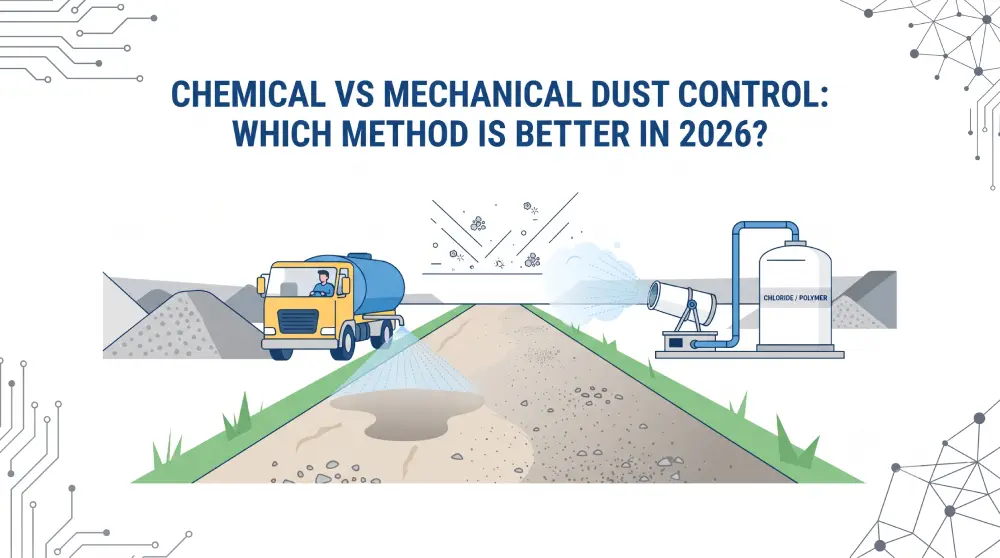
The fundamental difference between chemical and mechanical dust control methods lies in how they interact with the dust source. Mechanical approaches use physical barriers or repeated moisture application to temporarily suppress dust. Chemical dust control methods alter the surface properties of the material itself—binding fine particles together, attracting atmospheric moisture, or penetrating the road base to create a stabilized surface that resists erosion at the source.
Chemical dust control generally outperforms mechanical methods for long-term, high-traffic applications—but only if the chemical agent is matched correctly to site-specific conditions. Mechanical methods remain viable for temporary, low-traffic, or environmentally sensitive areas where soil chemistry compatibility is a concern. The optimal approach in many scenarios is an integrated strategy that uses chemical stabilization for primary haul roads and mechanical suppression for temporary access points.
What Are Mechanical Dust Control Methods?
Mechanical dust control methods rely on physical processes—applying moisture, creating barriers, or physically altering the road surface—to suppress dust generation. These methods do not chemically alter the dust particles or the road base material. Their effectiveness is temporary and directly tied to the frequency of application.
How Mechanical Methods Work
The core principle of mechanical dust control is straightforward: add enough moisture to the surface so that fine particles become heavy enough to resist becoming airborne. When water binds to dust particles through surface tension, the aggregate weight of wetted particles prevents them from being lifted by wind or mechanical disturbance. However, once the water evaporates—which happens rapidly in hot, dry, or windy conditions—the dust returns.
Common mechanical methods include water trucks with spray bars, misting cannons, and physical wind barriers such as fencing or berms. In road applications, grading and compaction can serve as mechanical interventions, though they require regular repetition as traffic degrades the compacted surface.
The Evaporation Problem
The most significant limitation of water-based mechanical dust suppression is evaporation rate. On a typical summer day in the southwestern United States, a water truck application may suppress dust effectively for only 2 to 4 hours. At surface temperatures above 35°C (95°F), that window shortens dramatically. For operations running 10 to 12-hour shifts, this means multiple water trucks running continuously—a cost that compounds when accounting for fuel, labor, equipment maintenance, and water sourcing.
A 2023 industry analysis found that a single water truck operating on a 5-mile unpaved haul road consumed approximately 20,000 to 30,000 gallons of water per day during peak summer conditions. Over a 6-month construction season, that equates to 3.6 million gallons of water at a delivered cost that can range from $0.005 to $0.05 per gallon depending on proximity to water sources.
What Are Chemical Dust Control Methods?
Chemical dust suppression represents a fundamentally different approach. Instead of simply adding temporary moisture, chemical agents interact with the road base or soil substrate to create a stabilized surface that resists dust generation over extended periods.
How Chemical Dust Control Works
Chemical dust control methods function through several distinct mechanisms, depending on the specific chemistry of the product used. Hygroscopic salts—the most widely used category—function by pulling moisture from the surrounding air and binding it to the road surface, maintaining a consistent moisture content even in arid conditions. Calcium chloride and magnesium chloride dominate this category due to their high hygroscopicity and cost-effectiveness.
Other chemical approaches include organic binders, synthetic polymer emulsions, and lignosulfonates. Each class of chemical agent works through a different mechanism: some penetrate the road base and bind particles at depth, while others form a surface crust that physically encapsulates fine particles. The selection of the appropriate chemistry depends on soil type, traffic volume, climate conditions, and environmental constraints.
Chemical Categories and Their Mechanisms
Understanding the available chemical categories is essential for matching the right product to site conditions. The following table summarizes the major categories and their primary mechanisms.
| Chemical Category | Mechanism of Action | Typical Longevity | Best Suited For |
|---|---|---|---|
| Hygroscopic Salts (CaCl₂, MgCl₂) | Attract and retain atmospheric moisture; depress vapor pressure to slow evaporation | 3–8 weeks per application | Unpaved roads, mine haul roads, arid climates |
| Organic Binders (lignosulfonates, molasses) | Adhere particles together through natural binding properties; form surface crust | 2–6 weeks per application | Temporary roads, low-traffic areas |
| Synthetic Polymers (polyvinyl acetate, acrylics) | Create durable surface crust through particle encapsulation | 6–12 months per application | High-traffic areas, long-term stabilization |
| Enzymatic Solutions | Catalyze soil compaction by altering clay particle structure | 3–6 months per application | Clay-rich soils requiring compaction |
Chemical vs Mechanical Dust Control: Head-to-Head Comparison
The decision between chemical and mechanical suppression involves trade-offs across multiple dimensions. A direct comparison across the factors that matter most to procurement teams and operations managers reveals where each approach excels—and where it falls short.
Effectiveness Over Time
Mechanical methods provide immediate but short-lived dust suppression. A water truck application begins losing effectiveness the moment it is applied, with a decay curve that accelerates under high temperatures and wind. Chemical methods, by contrast, increase in effectiveness during the first 24 to 48 hours as the product penetrates the road base and begins binding particles. Once fully activated, a properly applied chemical treatment maintains consistent dust suppression performance for weeks or months without reapplication.
Field data from unpaved mine haul roads in Australia demonstrated that calcium chloride-treated sections reduced PM10 emissions by 85% to 95% over an 8-week monitoring period, compared to untreated sections. Mechanical watering on the same roads required daily reapplication and achieved only 60% to 70% reduction averaged over 24-hour cycles, due to the evaporation gap between applications.
Cost Analysis Per Square Meter
The cost comparison between chemical and mechanical methods must account for both direct application costs and the frequency of reapplication. While a single chemical treatment typically costs more than a single water truck pass, the extended treatment interval dramatically shifts the total cost of ownership.
| Cost Factor | Mechanical (Water Truck) | Chemical (Hygroscopic Salt) |
|---|---|---|
| Initial application cost | $0.02–$0.05/m² | $0.15–$0.35/m² |
| Reapplication frequency | 1–3 times daily | Every 4–8 weeks |
| Annual application count | 180–540 applications | 6–12 applications |
| Equipment/fuel annual cost | $45,000–$120,000 per truck | $12,000–$28,000 per spreader |
| Water annual cost (5-mile road) | $18,000–$90,000 | Minimal (application only) |
| Estimated annual cost per mile | $35,000–$85,000 | $8,000–$22,000 |
Typical market reference values based on 2025–2026 North American pricing for a single-lane unpaved road with moderate traffic.
Environmental and Regulatory Considerations
Both methods carry environmental implications that affect permitting and compliance. Mechanical methods using only water present minimal environmental risk, making them suitable for environmentally sensitive areas where chemical introduction is restricted. However, the water consumption itself represents an environmental impact in water-scarce regions—3.6 million gallons annually for a single 5-mile road is not trivial.
Chemical methods require careful evaluation of runoff potential, groundwater proximity, and soil chemistry. The EPA regulates stormwater discharges from industrial activities, and facilities using chemical dust suppressants must ensure that runoff does not exceed water quality standards for chloride, biochemical oxygen demand, or other relevant parameters. That said, EPA recognizes calcium chloride and magnesium chloride as generally acceptable for dust control on unpaved roads when applied according to manufacturer specifications, citing their "low toxicity and minimal environmental persistence" compared to some synthetic alternatives.
Where Are Chemical Dust Control Methods Most Effective?
Chemical suppression delivers its strongest performance advantage in applications where consistent, long-duration dust control is required and where the logistics of frequent mechanical reapplication become cost-prohibitive.
Mining and quarry operations represent the most common high-value application. Haul roads in open-pit mines can extend for 10 to 25 miles and experience heavy truck traffic 24 hours per day. The cost of running water trucks continuously on these roads—and the productivity loss from wet, slippery surfaces—makes chemical stabilization the default choice for most large operations.
Unpaved public roads in rural counties and townships similarly benefit from chemical treatment programs. A 2024 study by a Midwestern U.S. county public works department tracked maintenance costs across 120 miles of gravel roads and found that roads treated with calcium chloride required 60% fewer grading passes annually and maintained higher surface quality scores compared to untreated sections.
Construction site perimeter control is another high-value application, particularly on large commercial or industrial projects where dust generation can affect neighboring properties and trigger regulatory complaints. Chemical treatment of construction entrances and perimeter haul routes provides documented compliance benefits without the constant water truck traffic that can create muddy conditions and safety hazards.
Where Do Mechanical Dust Control Methods Still Excel?
Despite the cost and performance advantages of chemical suppression in many applications, mechanical dust control methods maintain clear superiority in several specific scenarios.
Short-term projects lasting fewer than 30 days rarely justify the mobilization cost and site evaluation requirements of chemical treatment. A water truck can be deployed within hours, whereas chemical application typically requires soil analysis, product selection, and specialized application equipment scheduling that may take one to two weeks to coordinate.
Environmentally sensitive zones near surface water, wetlands, or protected habitats often restrict or prohibit chemical introduction regardless of the product's toxicity profile. In these areas, water-only mechanical suppression—combined with physical barriers and speed restrictions—represents the only compliant option.
Operations with variable traffic patterns also benefit from mechanical flexibility. When haul routes change weekly due to phased construction or mining sequencing, the investment in chemical treatment of a road section that will be abandoned within weeks makes limited economic sense. Water trucks can be rerouted instantly as operational needs evolve, while chemical treatment commits a road section to a specific treatment interval.
The World Health Organization has noted that "dust suppression using water alone remains the most universally applicable method where chemical soil interaction data is unavailable or where local regulations preclude chemical use." This reinforces that mechanical methods are not obsolete—they are the appropriate tool for specific, well-defined operational contexts.
How to Choose Between Chemical and Mechanical Dust Control
Selecting the right dust control approach requires evaluating site-specific conditions against the performance characteristics of each method. The following framework guides this decision.
Decision Matrix
Choose chemical dust control when:
- The treatment area will be in use for more than 60 days
- Water availability is limited or water delivery costs exceed $0.02 per gallon
- Consistent 24-hour dust suppression is required
- Traffic volume exceeds 50 vehicle passes per day
- Soil analysis confirms compatibility with the target chemical agent
- Regulatory permits allow chemical application
Choose mechanical dust control when:
- The project duration is less than 30 days
- Haul routes change frequently based on operational phasing
- The site is within 100 meters of surface water or protected habitat
- Soil chemistry data is unavailable and cannot be obtained within the project timeline
- Traffic volume is below 20 vehicle passes per day
- Regulatory restrictions explicitly limit or prohibit chemical use
Choose an integrated approach when:
- The site includes both permanent haul roads and temporary access points
- Budget constraints limit chemical treatment to the highest-traffic road segments
- Seasonal weather patterns create windows where mechanical-only is sufficient
- Environmental permits allow limited chemical application on specific road sections
Common Mistakes to Avoid in Dust Control Planning
Even experienced operations teams make predictable errors when evaluating dust control methods. Avoiding these mistakes improves both performance and cost outcomes.
Assuming water is the cheapest option without calculating total cost. The marginal cost of a single water truck pass looks low—often $0.02 to $0.05 per square meter. But multiplying that by 200 to 300 application days per year, plus fuel, labor, maintenance, and water delivery, frequently produces a total annual cost that is three to five times higher than chemical treatment. Conduct a full-year total cost analysis before concluding that water is the budget-friendly option.
Selecting a chemical product without soil analysis. Not all soils respond equally to all chemical agents. Clay-rich soils may achieve excellent stabilization with enzymatic products but perform poorly with hygroscopic salts. Sandy soils with low fines content may not respond to any chemical treatment and require mechanical methods or physical stabilization. A $500 to $1,500 soil analysis is cheap insurance against a $20,000 failed application.
Ignoring application rate precision. Both over-application and under-application of chemical suppressants create problems. Over-application wastes product, increases runoff risk, and can create slippery surface conditions. Under-application fails to achieve the target treatment interval and erodes confidence in chemical methods. Follow manufacturer application rate specifications precisely and calibrate spreading equipment before each treatment cycle.
Neglecting surface preparation. Chemical treatment applied to a poorly graded, potholed, or heavily corrugated road surface will underperform regardless of product quality. The road should be graded to proper crown, compacted to specification, and free of standing water before chemical application. Skipping this step is the most common cause of premature treatment failure.
The Future of Dust Control Methods: Trends Through 2026 and Beyond
The dust control industry is evolving in response to tightening air quality regulations, water scarcity pressures, and advances in both chemical formulation and application technology.
Real-time dust monitoring integration is becoming standard practice on large construction and mining sites. Networks of low-cost PM10 and PM2.5 sensors provide continuous air quality data that feeds into site management systems. When particulate levels exceed thresholds, automated alerts trigger suppression responses—whether that means dispatching water trucks or scheduling the next chemical treatment application. The EPA has increasingly accepted real-time monitoring data in lieu of periodic manual sampling, accelerating adoption.
Bio-based and biodegradable chemical formulations represent the fastest-growing product category. Traditional hygroscopic salts remain dominant, but new products derived from plant-based polymers, food processing byproducts, and biodegradable synthetic compounds are gaining market share in environmentally regulated markets. These products offer comparable performance to conventional chemicals with reduced chloride loading in runoff.
Precision application technology using GPS-guided spreaders and variable-rate controllers reduces product waste by 15% to 25% compared to manual application. Spray trucks equipped with automated flow control adjust application rates in real time based on vehicle speed and road segment data, ensuring consistent coverage and eliminating the over-application and under-application problems common with manual systems.
Water conservation mandates in drought-prone regions—including California, Arizona, Nevada, and parts of Australia—are driving regulatory shifts that increasingly favor chemical dust control methods over water-intensive mechanical suppression. Several California air quality management districts now recommend or require chemical stabilization for unpaved roads in nonattainment areas for PM10, explicitly citing the water conservation benefits alongside air quality improvements.
Conclusion
Chemical and mechanical dust control methods each serve distinct operational roles, and the "better" option in 2026 depends entirely on site conditions, project duration, and regulatory context. Chemical methods—particularly hygroscopic salts—deliver superior long-term performance at a significantly lower total annual cost for permanent and semi-permanent applications with moderate to heavy traffic. Mechanical methods using water application remain the correct choice for short-duration projects, environmentally constrained sites, and operations with rapidly changing traffic patterns.
The data consistently shows that chemical treatment reduces PM10 emissions by 85% to 95% over treatment intervals measured in weeks, while water-only suppression requires daily reapplication and achieves lower average 24-hour performance. The annual cost analysis similarly favors chemical methods by a factor of three to five times for permanent road applications, once all labor, fuel, water, and equipment costs are accounted for.
The most effective dust control strategy for the majority of medium and large-scale operations is not an either-or decision. An integrated approach—chemical stabilization on primary haul roads combined with mechanical suppression for temporary access points and environmentally sensitive perimeters—delivers optimized cost, performance, and compliance outcomes. Start with a comprehensive site assessment that includes soil analysis, traffic pattern mapping, and water availability evaluation before committing to any single method.
FAQs
What is the most effective dust control method for unpaved roads?
Hygroscopic salts, particularly calcium chloride and magnesium chloride, are generally the most effective dust control method for unpaved roads with regular traffic. They work by absorbing atmospheric moisture and binding fine particles together, providing consistent dust suppression for 4 to 8 weeks per application. Studies on mine haul roads and rural public roads demonstrate PM10 reductions of 85% to 95% when applied at the correct rate for the local soil type and climate conditions.
How long does chemical dust control last compared to water?
Chemical dust control using hygroscopic salts typically lasts 4 to 8 weeks per application under normal traffic and weather conditions. Synthetic polymer treatments can extend this to 6 to 12 months. In contrast, water-based mechanical suppression lasts only 2 to 4 hours before requiring reapplication in hot or windy conditions. This 500-fold difference in treatment interval is the primary driver of the cost advantage for chemical methods in permanent road applications.
How much does chemical dust control cost per mile?
Chemical dust control for a single-lane unpaved road typically costs $8,000 to $22,000 per mile annually, including product, application, and equipment costs. This compares to $35,000 to $85,000 per mile annually for mechanical water truck operations when fuel, labor, water delivery, and equipment maintenance are fully accounted for. Actual costs vary based on local water prices, traffic volume, and soil conditions.
Is chemical dust control safe for the environment?
Most widely used chemical dust suppressants, including calcium chloride and magnesium chloride, are recognized by the EPA as having low toxicity and minimal environmental persistence when applied according to specifications. However, application near surface water or in areas with high groundwater tables requires careful evaluation of runoff potential and chloride loading. Environmental permits and soil analysis are recommended before application in sensitive areas.
Can chemical dust control be used on construction sites?
Yes, chemical dust control is commonly used on construction sites, particularly for stabilizing entrance and exit points, perimeter haul roads, and material storage areas. It is most cost-effective on projects lasting more than 60 days where water truck logistics create significant expense. Short-term construction projects under 30 days generally find water-based mechanical suppression more practical due to lower mobilization requirements.
How does calcium chloride suppress dust?
Calcium chloride suppresses dust through two mechanisms: hygroscopic moisture absorption and vapor pressure depression. The salt attracts water molecules from the surrounding air and binds them to the road surface, maintaining a consistent moisture content even in dry conditions. It also depresses the vapor pressure of water in the treated surface, significantly slowing the evaporation rate. Together, these mechanisms keep fine particles heavy enough to resist becoming airborne for weeks after application.
What are the disadvantages of mechanical dust control?
The primary disadvantages of mechanical dust control are short duration of effectiveness, high water consumption, and total cost. Water-based suppression requires reapplication every 2 to 4 hours under summer conditions, which generates substantial fuel, labor, and equipment costs. A 5-mile unpaved road can consume 3 to 4 million gallons of water annually. Mechanical methods also create muddy conditions that can reduce vehicle traction and increase road maintenance requirements.
What is the difference between hygroscopic salts and polymer dust suppressants?
Hygroscopic salts like calcium chloride work by absorbing atmospheric moisture and maintaining surface moisture content over time. They are water-soluble and gradually leach from the road surface with rainfall, requiring reapplication every 4 to 8 weeks. Polymer suppressants form a physical crust or coating that encapsulates dust particles and resists water penetration. Polymers typically last longer—6 to 12 months—but cost more per application and require precise application conditions for proper curing.
When should mechanical dust control be used instead of chemical?
Mechanical dust control should be used when projects last less than 30 days, when haul routes change frequently, when the site is within 100 meters of surface water or protected habitat, when soil chemistry data is unavailable, or when local regulations restrict chemical use. Water-based suppression also serves as the only option in areas where chloride runoff limits have already been reached.
How does soil type affect dust control method selection?
Soil type is a critical factor in dust control method selection. Clay-rich soils with high fines content respond well to enzymatic products and hygroscopic salts, achieving strong compaction and particle binding. Sandy soils with low fines content may not bind adequately with any chemical treatment and may require mechanical methods or physical stabilization such as gravel capping. Soil analysis—including particle size distribution, plasticity index, and existing chloride content—should always precede chemical treatment selection.