
Industrial operations face a persistent air quality challenge. The dust generated by material handling, crushing, vehicle traffic on unpaved roads, and wind erosion doesn't just create a nuisance—it releases respirable particles into the air that carry serious health and regulatory consequences. PM10 dust and the even finer PM2.5 fraction are at the center of this concern.
Traditional responses often rely on water spraying alone. However, water evaporates quickly, especially in hot or windy conditions, leaving surfaces dry and dust active again within hours. Health, Safety, and Environment (HSE) professionals need solutions that address the particle physics at play. The effectiveness of a dust control program hinges on understanding how specific suppression mechanisms interact with airborne particulates. This article examines the science and engineering behind these methods.
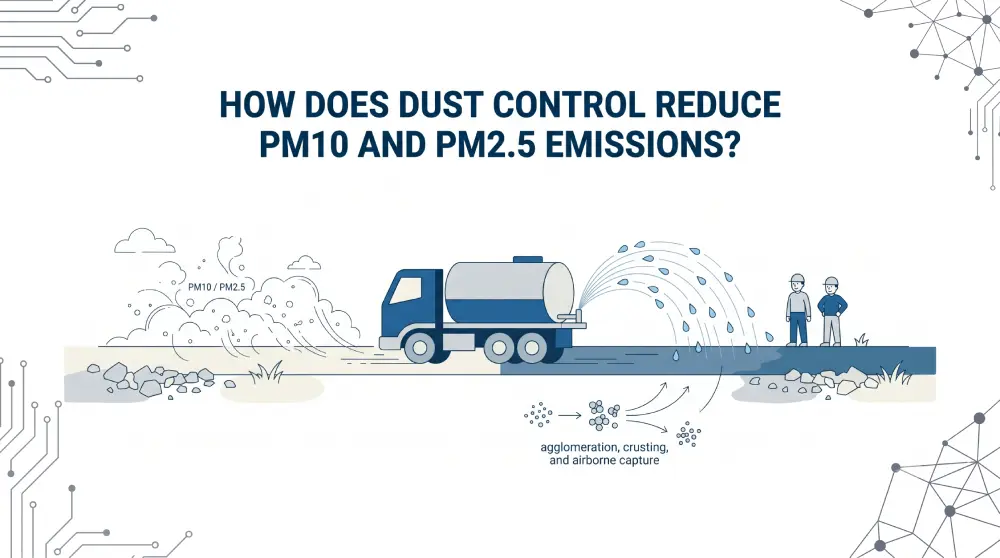
Dust control measures can reduce PM10 dust concentrations by up to 90% if the suppression method is matched to the particle size and application environment. The core mechanisms include agglomeration of fine particles, surface binding to prevent re-entrainment, and aerodynamic capture at emission points.
How Does Dust Generate in Industrial Settings?
Fugitive dust does not require complex industrial processes to become airborne. The physics of particle entrainment is straightforward: when the force of wind or mechanical disturbance exceeds the forces holding a particle in place—gravity, cohesion, and moisture—the particle lifts off.
What Role Do PM10 and PM2.5 Play in Air Pollution?
PM10 dust refers to particulate matter with an aerodynamic diameter of 10 micrometers or less. For scale, a human hair is about 70 micrometers in diameter. PM2.5, a subset of PM10, is even finer at 2.5 micrometers or less. Because of their small mass, these particles settle very slowly and can travel hundreds of miles from the source. They penetrate deep into the lungs, with PM2.5 capable of entering the bloodstream. Industrial activities like quarrying, mining, demolition, and bulk material handling are significant contributors to PM10 and PM2.5 emissions.
What Particle Forces Keep Dust Grounded?
Particles on a surface are subject to several inter-particle forces. Van der Waals forces create weak attraction between fine particles. Electrostatic charges can bind them together or to larger surfaces. Liquid bridges—tiny amounts of moisture—create capillary adhesion. Dust control strategies work by manipulating these forces. Water temporarily increases liquid bridging, but advanced chemical suppressants permanently enhance the Van der Waals and electrostatic bonds, even after the carrier water evaporates.
How Does Dust Control Reduce PM10 Emissions? The Core Mechanisms
Reducing airborne PM10 dust requires altering the physical properties of the particles so they resist becoming airborne. This is achieved through three primary mechanisms.
Agglomeration: Binding Small Particles Into Larger Ones
Fine particles like PM10 and PM2.5 are difficult to capture because of their low inertia. They follow air currents around obstacles. Agglomeration solves this by causing particles to adhere to one another, forming heavier clumps that either cannot become airborne or settle more rapidly.
Water alone can initiate agglomeration, but its effect is temporary. As the water evaporates, particles return to their original size and become active again. Hygroscopic salts such as calcium chloride and magnesium chloride absorb moisture from the air to keep surfaces continuously damp. Organic binders like lignosulfonates and tall oil emulsions act like a glue, physically cementing the particles together. A well-formulated suppression program can suppress dust for weeks or months, rather than the hours provided by water alone, significantly reducing maintenance costs and water consumption.
Surface Crusting and Stabilization
For unpaved haul roads, stockpiles, and exposed soil, the goal is to form a durable crust that resists wind erosion and vehicle shear forces. Here, the suppressant penetrates the top layer of fines and forms a crystalline or polymeric matrix upon drying.
Products like magnesium chloride hexahydrate develop a dense, interlocking crystalline structure that bonds surface particles. Polymeric emulsions form a continuous film that is flexible and water-insoluble, making them suitable for high-traffic areas. A stabilized surface can reduce PM10 emissions by 80% or more compared to an untreated road, according to field tests cited by the EPA in its AP-42 emission factors for paved and unpaved roads.
Airborne Capture and Suppression
Not all dust can be prevented from becoming airborne, especially at active drop points in processing plants. Fogging and misting systems apply the agglomeration principle in the air. The key is matching the water droplet size to the dust particle size.
If a water droplet is much larger than a PM10 particle (say, 200 microns), the slipstream effect occurs: the particle follows the air stream around the droplet and never contacts it. The Slipstream Effect is why traditional water sprays often fail to capture PM10 dust. Effective systems, such as dry fog or ultrasonic misting, produce droplets in the 10-15 micron range. These droplets and particles collide and agglomerate, with the resulting clusters falling out of the air or being captured by a dust collector.
Water vs. Chemical Dust Suppressants: A Performance Comparison
Water remains the most common dust suppressant, but its limitations are significant. Understanding where water fails is essential for HSE professionals designing a compliance program.
| Performance Factor | Water Alone | Chemical Suppressants |
|---|---|---|
| Duration of Control | Hours (evaporates quickly) | Weeks to months (hygroscopic or binding action) |
| PM10 Capture Efficiency | Low (slipstream effect) | High (matched droplet sizes, agglomeration) |
| Frequency of Application | Daily or multiple times per day | Weekly to quarterly, depending on traffic |
| Water Consumption | Very high | Can reduce water usage by up to 90% |
| Road Surface Impact | Creates mud, washboarding | Strengthens surface, reduces gravel loss |
| Freeze-Thaw Performance | Creates ice hazard in winter | Certain treated products remain effective below 0°F |
Chemical suppression is not a single solution but a toolkit. The choice between a hygroscopic salt, a polymer, or an enzyme-based binder depends on the local climate, the mechanical stresses on the surface, and the specific regulatory limits for PM10 and PM2.5.
Why Does PM10 Dust Control Matter for Regulatory Compliance?
HSE professionals operate under tightening regulatory frameworks. The link between airborne particulate matter and public health has driven stricter ambient air quality standards globally.
How Do PM10 Emissions Trigger Regulatory Action?
The EPA sets National Ambient Air Quality Standards (NAAQS) for PM10 and PM2.5. The current 24-hour standard for PM10 dust is 150 µg/m³, not to be exceeded more than once per year on average over three years. For PM2.5, the annual standard is currently 9.0 µg/m³. Sites with significant fugitive dust must develop a Fugitive Dust Control Plan, often as part of a Title V operating permit. Failure to demonstrate control can result in Notices of Violation, fines, and mandated production curtailments. Proactive dust control is a core element of maintaining an operation’s license to operate.
What Is the Health Rationale Behind PM10 Regulations?
The World Health Organization classifies diesel engine exhaust and outdoor air pollution as carcinogenic to humans. PM10 exposure is associated with increased hospital admissions for asthma, chronic obstructive pulmonary disease, and cardiovascular events. The smaller PM2.5 fraction is the most damaging, as it crosses the alveolar membrane into the bloodstream. A well-designed dust control plan is a direct public health intervention that protects not only the workforce but also downwind communities. By suppressing dust at the source, industrial operators prevent the migration of fine particulates that contribute to regional haze and non-attainment status.
A Framework for Designing a PM10 Dust Control Plan
A successful dust control program is systematic and defensible. The following engineering framework aligns with EPA guidance on reasonably available control measures.
Source Identification and Baseline Monitoring
Before selecting controls, you must map emission sources. Walk the site and log every material transfer point, active stockpile, unpaved road, and open area subject to wind erosion. Deploy reference-grade PM10 monitors, such as those based on beta attenuation or tapered element oscillating microbalance (TEOM) technology, to establish a baseline. Low-cost optical particle counters can supplement this data for spatial mapping but should be calibrated against a reference monitor. A baseline is essential for demonstrating the efficacy of the chosen control measures to regulators.
Matching Suppression Technology to the Emission Source
Every emission source has an optimal control technique.
- Unpaved Haul Roads: Treat with hygroscopic salts (calcium chloride or magnesium chloride) to maintain a high moisture-retention capacity. Apply using a pressurized distributor truck to achieve uniform penetration. Typical application rates range from 0.5 to 1.0 gallons per square yard, depending on traffic volume.
- Crusher and Transfer Points: Enclose the source and apply dry fog or water spray bars with a surfactant. The goal is to wet the material before it leaves the conveyor, preventing airborne dust generation entirely.
- Open Stockpiles: Use polymer surface crusting agents or vegetative wind barriers. A properly applied crust should withstand wind speeds of up to 40 mph. Application is often done with hydroseeding equipment.
- Plant Roads and Parking Lots: Apply emulsified asphalt or petroleum-based dust suppressants for long-term stabilization. This reduces re-entrainment from vehicle traffic by forming a durable, water-resistant surface.
How to Monitor and Validate PM10 Emission Reductions
A control measure is only effective if it is validated. HSE managers must move beyond visible opacity and toward real-time, data-driven compliance.
Selecting the Right Monitoring Equipment
Use EPA-designated Federal Reference Method (FRM) or Federal Equivalent Method (FEM) monitors for compliance reporting. For near-source monitoring, real-time optical sensors provide immediate feedback on the performance of misting systems. A common standard is the ISO 10473:2000 method for ambient air measurement. Data should be logged in 15-minute averages and correlated with meteorological conditions (wind speed, direction, humidity) to isolate the impact of your operations from regional background pollution.
Setting Key Performance Indicators for Dust Control
Effective KPI frameworks move beyond gallons of water sprayed. Instead, measure:
- PM10 Concentration Reduction: Percentage decrease in downwind vs. upwind PM10 levels during operations.
- Water Consumption Per Tonne of Material Processed: Track efficiency gains when switching to chemical suppressants.
- Corrective Action Closure Time: Hours from an operator-identified dust event to a documented mitigation response.
- Opacities: Use Method 9 certified observers or digital opacity cameras, but understand that opacity correlates poorly with PM10 mass; use it for operational trending, not mass compliance.
What to Look for in a Dust Control Program
Selecting the right approach for industrial dust suppression requires an assessment of the site’s operational demands and environmental constraints. An effective program is built on a site-specific plan rather than a single product. It should integrate both chemical and mechanical controls.
A comprehensive program begins with a detailed site survey that quantifies PM10 emission sources and their variability. The program design should specify suppression chemistries that are matched to the local soil type, traffic patterns, and climate. For example, areas with intense sun and low humidity benefit from hygroscopic salts, while high-rainfall regions may require water-insoluble polymers. Furthermore, the plan must include a robust monitoring and data management protocol to generate defensible compliance records and drive continuous improvement.
Conclusion
Understanding how dust control reduces PM10 and PM2.5 emissions is fundamental to modern industrial environmental management. The core mechanisms—agglomeration of fines, surface crusting, and airborne capture—work by altering the physical forces that allow tiny particles to become and remain suspended in air. A systematic plan that matches suppressants to specific sources and verifies performance with real-time monitoring is a non-negotiable element of regulatory compliance.
For HSE teams evaluating their fugitive dust program, the most important step is to characterize the particle size distribution of their emissions. If the problem is predominantly PM10 dust, traditional water-based methods will likely fall short. Prioritizing a scientific, data-backed approach to suppression is the only way to protect workers, the community, and the operational permit. Begin with a detailed site survey and baseline monitoring. From there, engineer the right combination of chemistry and mechanical controls to keep fine particles on the ground and out of the breathing zone.
FAQs
What is PM10 dust?
PM10 refers to inhalable particulate matter with an aerodynamic diameter of 10 micrometers or less. These particles are small enough to pass through the nose and throat and enter the lungs. Industrial sources include soil disturbance from construction, mining operations, and bulk material handling. Because they settle slowly, PM10 particles can remain suspended in the air for long periods and travel far from their original source.
How does a dust suppressant work?
A dust suppressant works by altering the physical bonding between fine particles on a surface. Some suppressants, like hygroscopic salts, absorb atmospheric moisture to keep surfaces continuously damp through liquid bridges. Others, like organic binders, physically cement the particles together into a durable crust that resists wind and mechanical forces, preventing PM10 re-entrainment.
How long does chemical dust control last?
The duration varies widely based on the product, application rate, and site conditions. Water alone may last only a few hours. Hygroscopic salts like calcium chloride can remain effective for several weeks under moderate conditions. Polymer binders and emulsified asphalt can stabilize a surface for several months, even under heavy industrial traffic, by forming a water-insoluble, mechanically durable crust.
What is the difference between PM10 and PM2.5?
The primary difference is size. PM10 particles have a diameter of 10 micrometers or less, while PM2.5 particles are 2.5 micrometers or less—about 30 times smaller than a human hair. PM2.5 is a subset of PM10. Because of their smaller size, PM2.5 particles penetrate deeper into the lungs, entering the gas-exchange region and even the bloodstream, making them a more severe health hazard.
Is fugitive dust a regulated pollutant?
Yes. The EPA regulates fugitive dust under the National Ambient Air Quality Standards (NAAQS) for PM10 and PM2.5. Industrial facilities are often required to implement a Fugitive Dust Control Plan as part of their operating permit. Failure to control fugitive dust can result in Notices of Violation, significant fines, and required production stoppages to bring a site back into compliance.
How do you measure PM10 dust emissions?
PM10 dust emissions are measured using reference-grade monitors that employ either beta attenuation monitoring (BAM) or tapered element oscillating microbalance (TEOM) technology. These EPA-designated Federal Reference Methods provide gravimetric data. Real-time optical particle counters are often used for site surveillance and mapping trends but must be correlated to a reference monitor for official compliance.
What are the health effects of PM10 dust?
Exposure to PM10 can aggravate respiratory conditions like asthma and bronchitis. The particles lodge in the upper airways, causing irritation and inflammation. Long-term exposure is linked to reduced lung function, chronic obstructive pulmonary disease, and cardiovascular strain. Workers in dusty trades and residents in communities with high PM10 levels face the greatest health risks.
What is the slipstream effect in dust control?
The slipstream effect occurs when a water droplet is too large to capture a fine dust particle. The particle follows the air stream around the droplet and continues to drift away without ever making contact. This is why standard water sprays often fail to suppress PM10. Effective systems must produce micron-sized droplets that match the particle size to cause a collision and agglomeration.
How can unpaved road dust be suppressed?
Unpaved road dust is suppressed by applying chemical binders that bind fine particles together or pull moisture from the air. Calcium chloride and magnesium chloride are common hygroscopic treatments. For longer-term control, polymer emulsions or lignosulfonates form a semi-rigid surface crust. The correct application rate and frequency depend on the traffic volume and local weather conditions.
When should a facility use a chemical suppressant instead of water?
A facility should switch from water to a chemical suppressant when water consumption becomes unsustainable, or when visible dust is controlled but fine PM10 is not. This is often due to the slipstream effect. Chemical suppressants are also necessary when freezing conditions create safety hazards with water, or when a surface requires a long-term stabilization treatment to reduce maintenance frequencies and vehicle-generated emissions.