
Dust affects far more than visibility. Across construction sites, manufacturing facilities, agricultural operations, mining areas, and transportation networks, uncontrolled airborne particles can reduce equipment reliability, increase maintenance costs, impact worker safety, and contribute to environmental compliance challenges. As industries place greater emphasis on sustainable operations, dust control has become an essential part of modern site management rather than a simple housekeeping task.
Traditional approaches often focus on removing dust after it has already become airborne. In practice, effective dust suppression begins much earlier by preventing particles from becoming suspended in the first place. Whether the source is an unpaved road, a conveyor transfer point, a stockpile, or a demolition project, selecting the appropriate control strategy depends on understanding how dust is generated and how different suppression technologies work.
Organizations today evaluate dust control solutions based on multiple factors, including long-term effectiveness, application frequency, operating costs, environmental impact, and regulatory requirements. Understanding these principles helps engineers, facility managers, contractors, and homeowners choose methods that fit their specific conditions instead of relying on temporary solutions.
Quick Answer
Dust control is the process of preventing airborne particulate matter from becoming suspended in the atmosphere by controlling moisture, stabilizing surfaces, capturing particles, or modifying industrial processes. Unlike simple cleaning, which removes settled dust after contamination has occurred, dust suppression reduces dust generation at its source. The most effective solution depends on particle size, environmental conditions, traffic intensity, and the characteristics of the material being handled. Because no single technology works for every situation, successful dust management typically combines engineering controls, operational practices, and ongoing monitoring.
What Is Dust Control?
Dust control refers to the collection of methods used to prevent, reduce, or eliminate airborne dust generated during industrial activities, transportation, agriculture, mining, construction, and material handling.
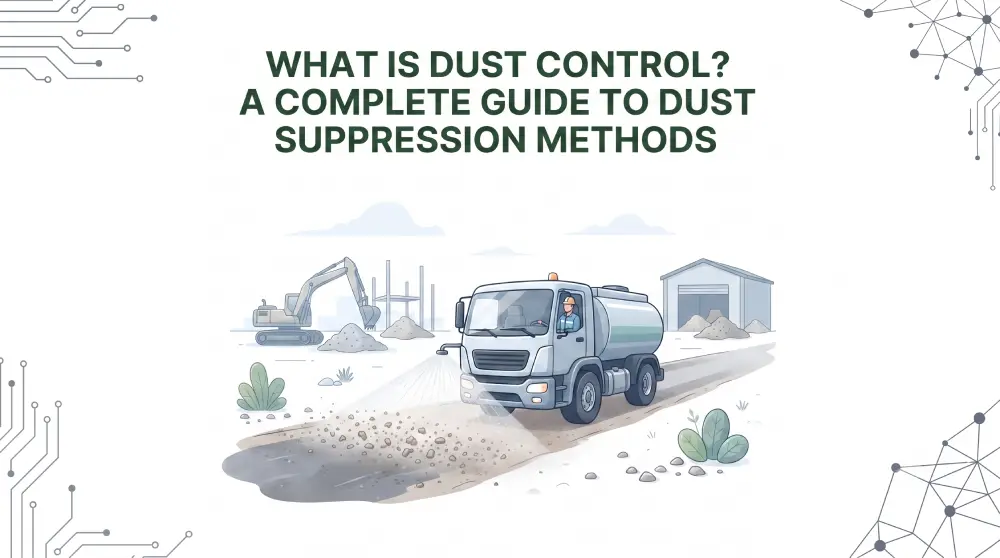
Rather than treating dust as a single problem, modern environmental management recognizes that different particle sizes behave differently. Larger particles generally settle quickly, while finer particles remain suspended for longer periods and may travel considerable distances before settling.
The following table summarizes the primary categories of airborne particles.
| Dust Type | Particle Size | Common Sources | Primary Concern |
|---|---|---|---|
| Total Suspended Particles (TSP) | Up to 100 μm | Earthmoving, road traffic | Visibility and nuisance dust |
| PM₁₀ | ≤10 μm | Construction, crushing, quarrying | Respiratory exposure |
| PM₂.₅ | ≤2.5 μm | Combustion, industrial processes | Long-term health impacts |
| Fugitive dust | Variable | Stockpiles, haul roads, wind erosion | Environmental compliance |
Dust control programs generally pursue several objectives:
- Reduce airborne particle emissions.
- Improve workplace visibility.
- Protect employee health.
- Minimize equipment wear.
- Reduce material loss.
- Support environmental compliance.
- Improve operational efficiency.
The U.S. Environmental Protection Agency (EPA) reports that particulate matter can affect both human health and environmental quality, making effective dust management an important component of air quality programs.
Although regulations differ between countries and industries, controlling airborne particulate matter has become a standard environmental objective across many industrial sectors.
How Does Dust Become Airborne?
Dust is generated whenever external forces overcome the natural attraction between small particles.
Several mechanisms contribute to dust generation, often occurring simultaneously within industrial operations.
Mechanical Disturbance
Excavation, crushing, drilling, screening, and conveyor transfer points continuously break larger materials into finer particles. The smaller the particle, the easier it becomes airborne.
Vehicle Traffic
Heavy trucks traveling on unpaved roads repeatedly disturb loose surface materials. Continuous traffic creates new fine particles while lifting previously settled dust into the air.
Wind Erosion
Open storage yards, mine tailings, agricultural fields, and exposed soil are particularly vulnerable to wind. As wind speed increases, the lifting force acting on loose particles also increases.
Low Moisture Content
Dry materials separate much more easily than moist materials. Even a modest increase in surface moisture can reduce dust emissions under many operating conditions.
Material Characteristics
Some materials naturally contain higher proportions of fine particles or possess lower particle cohesion, making them inherently more susceptible to dust generation.
Understanding these mechanisms is essential because different causes require different control strategies. A haul road experiencing traffic-related dust may benefit from hygroscopic materials, while an indoor manufacturing process may require mechanical dust collectors or local exhaust ventilation.
What Are the Main Dust Suppression Methods?
Modern dust suppression technologies can be divided into several major categories. Each method reduces airborne particles through a different physical or chemical mechanism, making the selection process dependent on operating conditions rather than a single "best" solution.
| Method | Primary Mechanism | Typical Applications | Advantages | Limitations |
|---|---|---|---|---|
| Water Spraying | Increases surface moisture | Construction, demolition, temporary roads | Low initial cost | Rapid evaporation, frequent application |
| Hygroscopic materials | Absorb moisture from the atmosphere | Gravel roads, mining haul roads | Longer residual effect | Performance depends on humidity |
| Polymer Surface Stabilizers | Bind particles into a protective layer | Soil stabilization, stockpiles | Improved erosion resistance | Higher initial material cost |
| Lignosulfonates | Natural particle binding | Forestry roads | Renewable resource | Shorter service life |
| Bituminous Products | Seal loose surfaces | High-traffic industrial roads | Durable under heavy traffic | Limited environmental suitability |
| Mechanical dust collectors | Capture airborne particles through filtration | Manufacturing, processing plants | High collection efficiency | Equipment maintenance required |
In many facilities, combining multiple methods produces better results than relying on a single technique. For example, a mining operation may use water sprays at crushers, install dust collectors at conveyor transfer points, and apply hygroscopic treatments to haul roads. Similarly, a construction site may combine water trucks with temporary surface stabilizers to reduce emissions during extended projects.
The effectiveness of each method also depends on environmental factors such as rainfall, relative humidity, temperature, traffic volume, and the particle size distribution of the material being managed.
Why Do Hygroscopic Materials Improve Dust Control?
Among the available suppression technologies, hygroscopic materials are widely used for controlling dust on roads and other unpaved surfaces because they help maintain surface moisture over an extended period.
These materials attract water vapor from the surrounding air and retain moisture within the road surface. As a result, fine particles remain bonded together instead of becoming airborne when disturbed by vehicles or wind.
Common hygroscopic dust suppressants include:
- Calcium chloride
- Magnesium chloride
- Blended chloride formulations
Compared with repeated water spraying, hygroscopic treatments generally require fewer applications under suitable environmental conditions. However, their performance varies depending on factors such as relative humidity, precipitation, drainage conditions, traffic intensity, and soil composition.
Typical applications include:
- Mining haul roads
- Quarry access roads
- Industrial logistics yards
- Forestry roads
- Rural gravel roads
- Temporary construction roads
While hygroscopic materials can significantly improve dust suppression performance in many situations, they are not appropriate for every environment. Site conditions, climate, maintenance practices, and environmental regulations should all be evaluated before selecting this approach.
Common Mistakes to Avoid
Choosing the wrong dust control strategy often results in higher operating costs and inconsistent performance. The following misconceptions are among the most common.
- Assuming every type of dust behaves the same. Coarse road dust and fine PM₂.₅ particles differ significantly in suspension time, transport distance, and control requirements. Effective suppression begins with understanding particle characteristics.
- Relying exclusively on water. Water provides immediate suppression but often evaporates rapidly during hot, dry, or windy weather, requiring frequent reapplication.
- Ignoring environmental conditions. Temperature, humidity, rainfall, wind speed, and seasonal variation all influence the effectiveness of dust suppression methods.
- Selecting technologies based only on purchase price. Lower initial costs may result in higher long-term expenses if repeated applications, additional labor, or increased water consumption are required.
- Neglecting routine maintenance. Even well-designed dust management programs require regular inspection, monitoring, and adjustment to maintain consistent performance over time.
Effective dust control is achieved by matching the suppression technology to the source of dust, operating conditions, maintenance capabilities, and environmental objectives rather than applying the same solution across every situation.
Where Is Dust Control Used?
Although the principles of dust control remain consistent, implementation varies considerably across industries because dust sources, operating conditions, and performance requirements differ.
Mining and Quarrying
Mining operations generate large amounts of dust from drilling, blasting, crushing, screening, and heavy vehicle traffic. Because haul roads often account for a significant share of site dust emissions, operators commonly combine road surface treatments with water sprays and enclosed processing equipment.
Typical objectives include:
- Reducing airborne dust along mining haul roads
- Improving driver visibility
- Extending equipment service life
- Supporting environmental compliance
Construction
Construction projects create dust during excavation, demolition, grading, cutting, and material transport. Since site conditions change daily, flexible suppression methods are often preferred.
Common approaches include:
- Water spraying
- Temporary surface stabilization
- Wind barriers
- Covered material storage
- Wheel washing systems
Agriculture
Agricultural dust originates from tillage, harvesting, livestock operations, and unpaved farm roads. Seasonal weather conditions strongly influence emission levels, making dust management an ongoing operational practice rather than a one-time treatment.
Manufacturing
Industrial facilities often control dust inside buildings through engineering systems rather than outdoor suppression methods.
Typical technologies include:
- Mechanical dust collectors
- Local exhaust ventilation
- Enclosed conveyors
- Filtration systems
- Automated cleaning equipment
Transportation and Logistics
Distribution centers, ports, and industrial yards frequently experience dust generated by truck movement and bulk material handling. Combining operational controls with road surface treatments can help reduce dust while maintaining traffic efficiency.
Water vs Hygroscopic Materials: Which Dust Suppression Method Is Better?
Neither approach is universally superior. The better option depends on climate, operating conditions, maintenance resources, and project objectives.
| Comparison Factor | Water Spraying | Hygroscopic Materials |
|---|---|---|
| Initial Cost | Lower | Higher |
| Residual Performance | Hours | Days to weeks (depending on conditions) |
| Water Consumption | High | Lower after application |
| Application Frequency | Frequent | Less frequent |
| Suitable for Temporary Work | Excellent | Good |
| Suitable for Long-Term Roads | Limited | Better suited |
| Weather Sensitivity | High evaporation | Dependent on relative humidity |
For example:
Choose water spraying when:
- Dust control is required for only a short period.
- Immediate suppression is the primary objective.
- Water resources are readily available.
- Daily application is practical.
Choose hygroscopic materials when:
- Roads experience continuous vehicle traffic.
- Water availability is limited.
- Longer-lasting suppression is preferred.
- Regular maintenance intervals can be planned.
This comparison illustrates an important principle: the most effective dust control strategy depends on operational requirements rather than selecting the same technology for every site.
Best Practices for Effective Dust Control
A successful dust management program involves more than selecting a suppression product. Long-term performance depends on planning, monitoring, and adapting to changing operating conditions.
The following practices are widely recommended across industries:
- Identify the primary dust source before selecting a suppression method.
- Measure particle size distribution where monitoring data are available.
- Match suppression technology to climate and site conditions.
- Reduce unnecessary vehicle speeds on unpaved roads to minimize dust generation.
- Maintain treated surfaces through regular inspections and timely reapplication.
- Monitor weather conditions, particularly wind speed and humidity.
- Evaluate total life-cycle costs instead of comparing only initial application expenses.
- Review environmental regulations applicable to the operating location before implementing any dust suppression program.
These practices help improve consistency while reducing unnecessary material use and operational interruptions.
Conclusion
Dust control is most effective when it addresses the source of airborne particles rather than simply treating the symptoms after dust has already dispersed. Understanding how dust forms, how particle size influences behavior, and how different suppression technologies perform under varying environmental conditions allows organizations and individuals to make more informed decisions.
From water spraying and hygroscopic materials to mechanical dust collectors and surface stabilization, every method has advantages and limitations. The appropriate solution depends on factors such as climate, traffic intensity, material properties, maintenance resources, and operational objectives rather than a single universal approach.
The key is to evaluate the dust source first, then select suppression methods that match both technical requirements and long-term operational goals. Applying this structured approach can improve air quality, reduce maintenance demands, and support safer, more efficient operations.
FAQs
What is dust control?
Dust control is the process of preventing or reducing airborne particles generated by activities such as construction, mining, agriculture, manufacturing, and transportation. It combines methods like water application, surface stabilization, hygroscopic treatments, and dust collection systems to minimize emissions, improve air quality, and reduce operational and environmental impacts.
How does dust suppression work?
Dust suppression works by preventing fine particles from becoming airborne. Depending on the method, it may increase surface moisture, bind particles together, stabilize exposed soil, or capture dust through filtration. The most effective approach depends on particle size, weather conditions, traffic levels, and the characteristics of the material being handled.
What is the difference between dust control and dust suppression?
Although the terms are often used interchangeably, dust control is the broader concept. It includes planning, monitoring, engineering controls, and maintenance practices. Dust suppression specifically refers to techniques that reduce airborne dust generation, such as spraying water, applying hygroscopic materials, or using chemical suppressants.
Is water the best method for dust control?
Water is one of the most common dust suppression methods because it is inexpensive and provides immediate results. However, it often evaporates quickly, especially in hot or windy conditions. For long-term applications such as unpaved roads or mining haul roads, other methods may provide longer-lasting performance with fewer applications.
What industries use dust control systems?
Dust control is widely used in mining, quarrying, construction, manufacturing, agriculture, ports, recycling facilities, bulk material handling, logistics yards, and transportation infrastructure. Each industry selects suppression methods based on dust sources, operating conditions, environmental requirements, and maintenance capabilities.
How effective are hygroscopic dust suppressants?
Hygroscopic dust suppressants attract and retain moisture from the surrounding air, helping keep surface particles bonded together. Under suitable humidity conditions, they generally provide a longer residual effect than water alone. Their effectiveness varies depending on climate, traffic intensity, rainfall, soil characteristics, and maintenance practices.
What are the main factors when choosing a dust control method?
Important considerations include particle size, dust source, weather conditions, surface material, traffic volume, available water, environmental regulations, maintenance frequency, and overall operating costs. Evaluating these factors together usually leads to a more effective and sustainable dust management strategy.
Is dust control important for workplace safety?
Yes. Effective dust control can improve visibility, reduce worker exposure to airborne particulate matter, minimize equipment contamination, and help create safer working environments. In many industries, dust management also supports regulatory compliance and reduces the likelihood of operational interruptions caused by excessive dust.
Can dust control reduce environmental impacts?
Yes. Proper dust control can reduce fugitive dust emissions, limit the spread of particulate matter to surrounding areas, decrease material loss, and improve local air quality. The environmental benefits depend on selecting suppression methods that are appropriate for the specific site conditions and operational requirements.
How often should dust suppression treatments be applied?
Application frequency depends on the suppression method, traffic levels, weather, and the material being treated. Water may require multiple applications per day in dry conditions, while longer-lasting surface treatments may remain effective for several days or weeks. Regular site inspections help determine the appropriate maintenance schedule.